.5B
Sarvam just raised 234 million dollars and crossed the unicorn line, valued at 1.5 billion dollars. The Bangalore startup builds AI models in Indian languages, and already supports millions of farmers and policy holders across the country.
The Gist
- Sarvam raised 234 million dollars at a 1.5 billion valuation, led by HCLTech with 150 million committed.
- The startup builds open source AI models, voice systems, and document tools tuned for Indian languages.
- Sarvam already handles 2 million conversations daily and supports 17 million farmers for the government.
Have ChatGPT Recap This Article
ChatGPTA funding round that opens a new chapter
Sarvam closed a Series B round of 234 million dollars announced on June 15. The deal pushes the company to a valuation of 1.5 billion dollars, which crosses the symbolic unicorn threshold for the first time. The startup is now India’s newest AI unicorn, and one of the most watched companies in the Bangalore tech scene.
The lead investor is HCLTech, a giant of the Indian IT services industry, with a 150 million dollar check. The round also brings in big names like Bessemer Venture Partners, Khosla Ventures, and Peak XV Partners. The presence of those funds confirms that international investors see Sarvam as a credible bet on Indian AI.
Before this round, Sarvam had raised about 41 million dollars across earlier seed and Series A stages. So the new injection multiplies its lifetime funding by nearly six. The total Series B target sits at 300 million dollars, which means the company is still open to closing more later in the year.
The founders, Vivek Raghavan and Pratyush Kumar, both come from AI4Bharat, a research lab at IIT Madras. They have spent years building tools for Indian languages, often in partnership with public institutions. Their academic roots give Sarvam a different DNA from typical Bay Area AI startups.
According to the founders, the ambition is to spread the technology widely across India and create value across sectors. The phrasing matters. Sarvam is not chasing a Silicon Valley exit. It wants to become a piece of national digital infrastructure, similar to what UPI did for payments.
What Sarvam actually builds
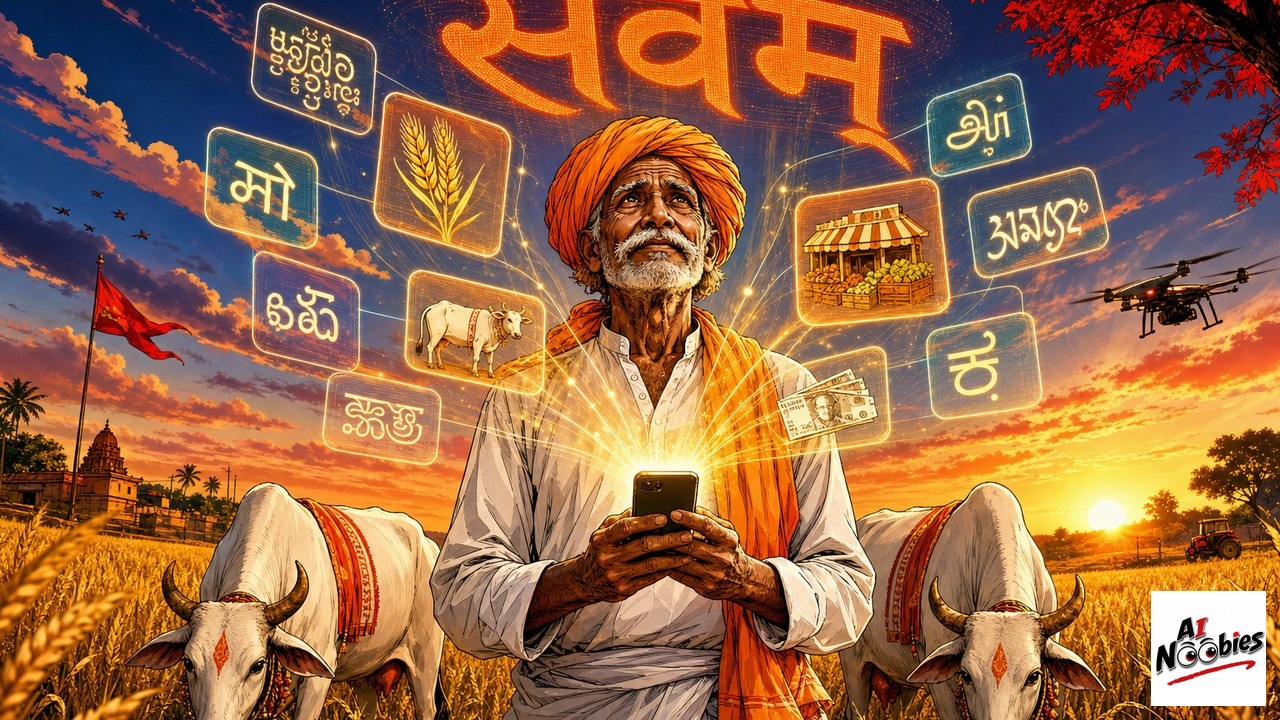
The product range of Sarvam is wide, and built around one key idea. Make AI work for Indian languages, not just English. The country counts more than twenty official languages, and most foreign AI models struggle to handle them well. Sarvam tunes its systems on local data to fill that gap.
At the core sit foundation models with 30 billion and 105 billion parameters, both released under open source licenses. A foundation model is a large AI brain that you can plug into different applications. By making them open, Sarvam invites developers across India to build their own products on top.
Around those models, Sarvam offers a conversational AI platform, an inference layer for fast responses, speech models for voice transcription, document AI tools to read scanned papers, and agentic AI platforms where the system performs tasks on its own. The catalog covers most of what an Indian enterprise would need to deploy AI from scratch.
The scale of usage is striking for a young company. Sarvam already runs 2 million conversational interactions daily, 10 million API calls, and more than 500,000 hours of audio transcribed monthly. Over 35 million document pages have been digitized through its systems. Those numbers prove the technology works at scale, not just in a demo.
Deployments cover banking, insurance, government agencies, and even defense. One contract supports 17 million farmers for the Ministry of Agriculture. A voice campaign assisted 45 million insurance policy holders. A large fintech runs the platform across 350,000 sales reps. Sarvam reaches millions of people who often do not speak English at all.
Keep learning on AI Noobies:
- Facebook’s New AI Reads All Your Public Posts
- Google’s New Format Lets AI Agents Share Knowledge
- KPMG AI report pulled after invented client cases
What this means for the AI map
The rise of Sarvam matters beyond the funding number. It confirms that Indian AI is starting to produce serious challengers, not just outsourcing contracts. With 1.5 billion dollars on the books, the startup can hire top researchers, expand cloud capacity, and compete head to head with US and Chinese model makers on its home turf.
For everyday users in India, the most direct impact will come through voice. Speaking to a smartphone in Hindi, Tamil, Telugu, or Bengali and getting a clean answer is still hit or miss with global tools. Sarvam’s specialized speech models could close that gap quickly, especially in rural areas where typing in English is not realistic.
For Indian developers, the open source angle is the real opportunity. Open models can be fine-tuned and deployed without paying a US vendor for every API call. A small startup in Mumbai or Hyderabad can build a product that runs entirely on Indian infrastructure, which lowers cost and keeps the data inside the country.
On the global map, Sarvam strengthens a trend already visible with companies like Mistral in France or DeepSeek in China. National AI champions are emerging in regions that previously depended fully on US tech giants. The Indian government, which has pushed for digital sovereignty for years, is likely to back Sarvam with more public contracts.
In the medium term, the test will be the international move. Many Indian AI tools work brilliantly inside India but rarely cross borders. If Sarvam can adapt its models to Southeast Asia or Africa, where many languages also suffer from poor AI coverage, the company could become a global player rather than a domestic champion.
Follow the story on AI Noobies.
About the Author