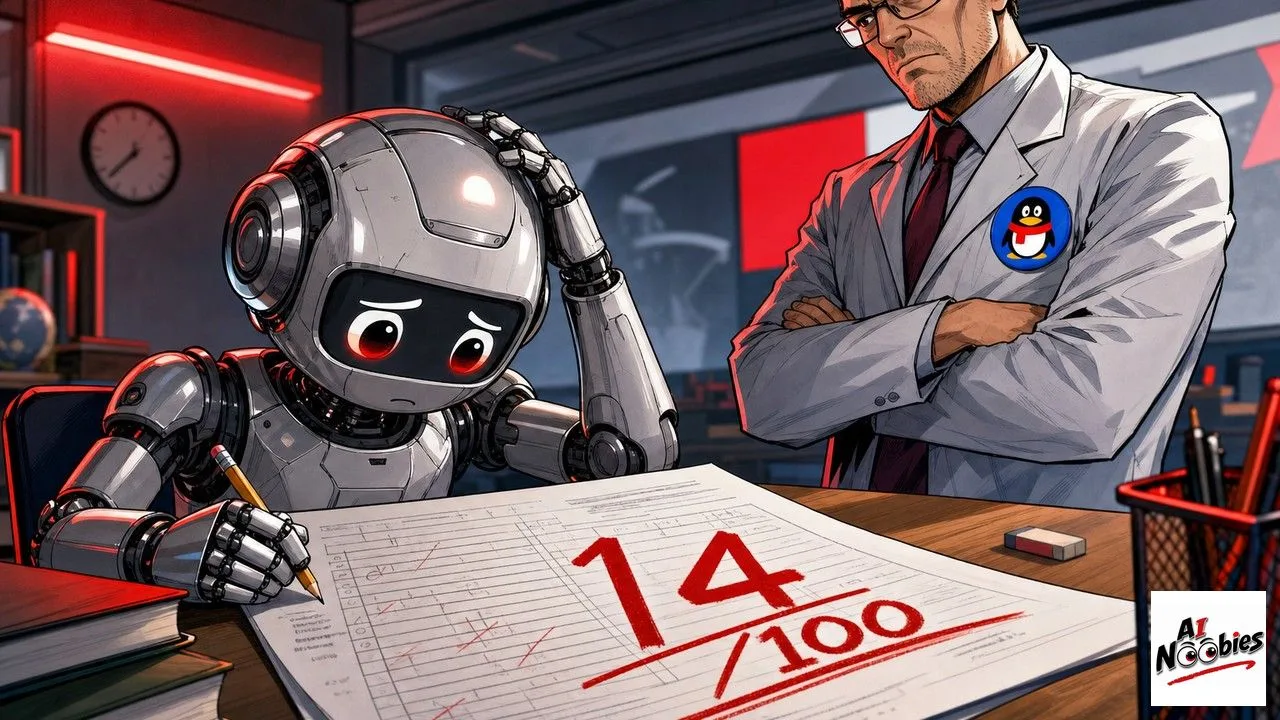
The latest AI Agents Reality Check is brutal. A research team at Tencent and Chinese universities tested how often AI agents actually finish a real online task on their own, and the score is 14 percent. The chatbot that answers your questions is one thing. The robot that gets the job done is still very much a work in progress.
The Gist
- An AI agent is software that tries to do tasks for you, like filling a form or buying a ticket, not just answer a question.
- GPT-4 only finished 14 percent of the everyday web tasks it was asked to handle in this Tencent test.
- Keeping the instructions visible at all times worked far better than asking the agent to fetch them when needed.
Have ChatGPT Recap This Article
ChatGPTWhat the test actually measured
An AI agent is software that goes one step beyond a chatbot. Instead of answering a question, it tries to do the task for you. Book a flight. Fill a spreadsheet. Click around a website until the job is done.
The research team ran a benchmark called WebArena. It is a fake but realistic version of the open web where the agent has to navigate, read, click and check the result. GPT-4, the model many readers may know through ChatGPT, finished 14 percent of those tasks.
That number is the key shock. The same model that gives you a clean answer to almost any question gets stuck the moment it must chain several actions together. Answering and doing are two very different skills, and the gap is wider than the marketing suggests.
There is also a wider message. Demo videos show agents finishing impressive tasks because the demo is staged. Real life throws weird buttons, broken layouts and unexpected pop-ups. That is exactly where the 14 percent figure comes from.
If you want to dig into the full picture, the same study has been broken down in more depth for an industry audience. Horizon covers the technical numbers in detail here, including how the agents fail when they try to use their own toolbox.
Why so much fails: the context puzzle
The most surprising finding is about how the agent receives its instructions. Researchers compared two methods. In the first, the agent is given a toolbox of skills it can call on demand. In the second, the instructions are always present in front of it, like a sticky note that never leaves.
The toolbox method should be more elegant, more efficient, more like how a human works. In practice, it failed badly. Agents missed the chance to use the toolbox 56 percent of the time, and even when they used it, success only reached 79 percent.
The sticky note method, where the documentation just stays visible, hit 100 percent success on the same task list. The simple, always-on context beats the clever, on-demand one. That feels counterintuitive, but it matches what many engineers had already noticed by trial and error.
There is a price to pay. Keeping all the documentation visible costs more tokens, which means a more expensive bill at the end of the month. The lesson is that reliability and cost are pulling in opposite directions, and the industry has not solved that tradeoff yet.
Some products are already pushing the boundary. AI loops that code while you sleep rely on the same pattern of persistent context, with humans checking the work in the morning. Those setups are closer to a coworker, but they still need a watchful human at one end.
Keep learning on AI Noobies:
- Anthropic Mythos: 100 Companies Get Trump’s Green Light
- GPT-5.6: White House Picks Who Gets It First
- Claude Tag: Anthropic’s Always-On Slack Assistant
How to Read the 14 Percent Score in Real Life
In the short term, the takeaway is reassuring. AI agents are not about to silently log into your email and run your whole day. The 14 percent score means that for now, an agent left fully alone fails more often than it succeeds in any realistic setup.
In the medium term, three to six months, the picture is more uneven. Companies will keep deploying agents for narrow tasks where 14 percent of completed runs is enough, especially when each run only costs a few cents. The agent might fail, but the human cost of trying is low, so the math still works for the company.
For everyday users, the right reflex is to keep your guard up. Any tool advertised as a fully autonomous AI assistant likely lives inside that same gap between demo and reality. Trying it on small, low-stakes tasks before trusting it with anything that matters is the safer route.
For workers worried about their job, the news cuts both ways. The Tencent study shows that the autonomous coworker promise is still distant. But the same study also shows that with enough engineering, agents will keep eating into specific tasks one at a time, even before they ever reach 100 percent reliability. AI Noobies stacked the 86 percent failure number against the winners in a reality check.
The honest reading of the AI Agents Reality Check is somewhere in the middle. AI agents are not magic and they are not useless. They are unfinished, getting better fast, and best treated today as a sidekick that always needs a final human eye before the result goes out.
Stay tuned on AI Noobies.
About the Author