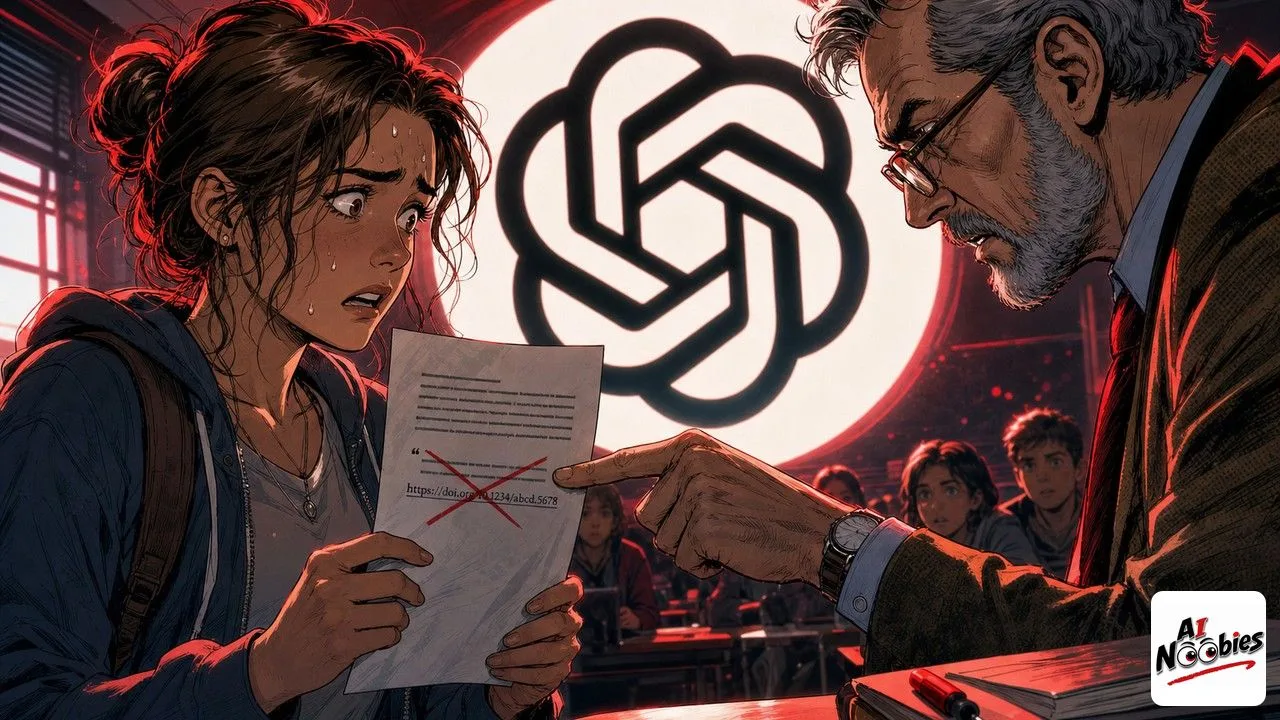
ChatGPT sometimes tells you things that sound rock solid but are completely invented. These moments are called ChatGPT hallucinations, and if you don’t learn to spot one, you can send a fake source to your boss or hand in a paper with a citation that never existed.
The Gist
- Hallucinations come from the way ChatGPT builds its answers, and no future update will fully remove them.
- The tool tends to sound most confident precisely when it should be most careful.
- Two simple habits catch the vast majority of made-up facts before they cost you.
Have ChatGPT Recap This Article
ChatGPTWhat ChatGPT Actually Does When It Answers You
ChatGPT does not really know facts. What it does is predict the next word based on patterns learned from billions of documents. That is the entire mechanism behind every answer you have ever received from it.
Most of the time, the prediction lands on something correct. But when the tool hits a gap in what it has actually seen, the generation does not stop. It fills the gap with something that sounds right. A ChatGPT hallucination is that gap-filling moment, when the model invents a name, a source or a date because the next-word prediction has nowhere else to go.
This is not a defect that a future patch will remove. It is built into how large language models work today, and every serious lab shipping a chatbot warns users about it. Some of the biggest names in AI have spent years explaining that generative tools can produce output but cannot verify their own claims.
The stakes are not abstract. A Big Four consulting firm quietly pulled its flagship AI report after fabricated client cases surfaced, and multiple law firms have been sanctioned over the past three years for submitting briefs full of court decisions that never existed. If professionals with real oversight get caught, a casual user with no fact-checker is even more exposed.
Three Red Flags a Beginner Can Always Catch
You do not need to understand how the model works to catch a hallucination. You only need to notice three patterns that appear again and again in ChatGPT hallucinations, and each one is spottable in under a minute.
The first red flag is a suspiciously precise source that you cannot verify anywhere else. When the tool gives you a paper title with an author, a journal, a year and a page number that all sound perfectly plausible, take thirty seconds to search the exact title in Google Scholar or on the journal’s own site. If nothing comes up, the source is very likely invented. Real papers leave a trail. Fake ones simply vanish under a search bar.
The second red flag is the tool sounding confident about something it should not know. That includes recent events after its training data cut-off, small local businesses, private individuals and niche technical specs. If the answer flows like it was written by someone who was there, and you know the topic is either obscure or too new to be in the training data, treat every detail as a claim rather than a fact.
The third red flag is numbers and dates that shift between two identical questions. Ask the same question in a fresh conversation window. If you get a different number, or a slightly different date, the tool is guessing every time. It generates a brand new answer from scratch on each run, and the two runs disagree because both were invented.
These three flags cover most of the ChatGPT hallucinations that hurt beginners. A quick check on any cited source, a raised eyebrow on suspicious confidence, and a second identical question in a new chat window. That is your basic detection kit, and it takes about two minutes to apply.
Keep learning on AI Noobies:
- Gemini Spark Mac Now Does Your Tasks for You
- 5 Free AI Tools Every Beginner Should Try in 2026
- Claude Sonnet 5 Now Free and Better for Agents
Simple Habits That Keep You Safe
Once you have the flags, real protection comes from a few small habits you build into every conversation. None of them are technical, and all of them can be picked up in a single afternoon of practice.
Ask ChatGPT explicitly for its sources and then open them yourself. Click any URL the tool cites. Search the title of any study it names. This routine costs you sixty seconds per answer and catches most invented references on the first click. The head of Signal has publicly warned that AI chatbots are not your friends, and the practical translation of that warning is exactly this: verify what they tell you before you act on it.
Add a short instruction to your prompt asking the tool to admit uncertainty. Something as plain as “if you are not sure, just say so instead of guessing” pushes the model to hedge on the parts where a hallucination is most likely. This will not eliminate the risk, but it flags it. When ChatGPT writes “I am not certain, but…”, read the answer with much more caution than you would give a confident reply.
Cross-check anything important with a plain search engine before you send it, ship it or hand it in. If ChatGPT says a book, a person or a study exists, verify by looking outside the tool. Google, Wikipedia, official sites. This step is boring and it works. The reason most viral hallucination stories involve lawyers and consultants is that these professionals skipped this exact step. A senior AI researcher has argued that generative tools can create but not evaluate their own output, which is the technical way of saying the tool cannot check its own work. You have to.
ChatGPT is a genuinely useful tool for drafting, brainstorming and summarizing. The trap is treating it like a reference book. It is not. Treat it like a fast, confident assistant with an unreliable memory, and it becomes an asset instead of a landmine.
Stay tuned on AI Noobies.
About the Author