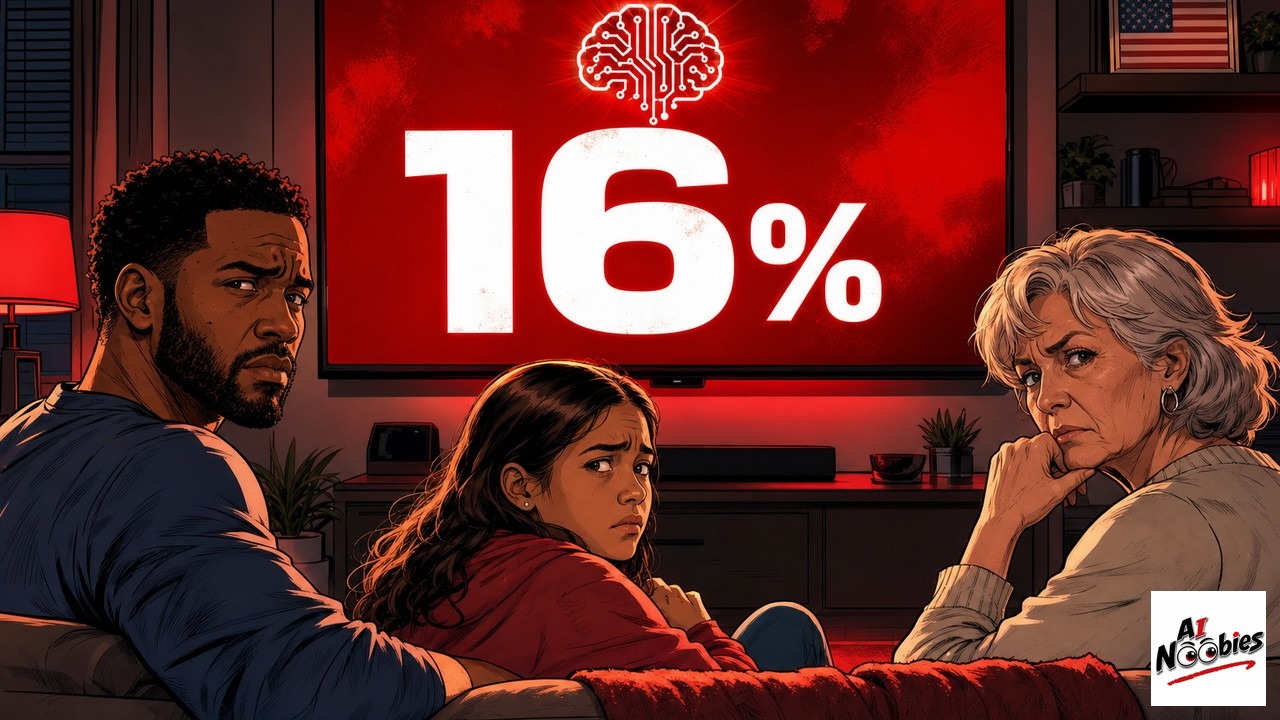
A new Pew Research study lands a sobering number: only 16% Americans AI optimism remains, when asked whether artificial intelligence will have a positive impact on society over the next twenty years. About 40% expect a negative impact, and the youngest adults are the most pessimistic of all.
The Gist
- Only 16% of Americans believe AI will positively shape society over the next 20 years
- Under 30s are the most skeptical group, with just 14% expecting a positive impact
- 67% doubt the US government will meaningfully regulate AI, and 59% distrust AI companies on safety
The numbers behind the doubt
When asked to project twenty years out, only 16% Americans AI optimism remains. Around 40% expect a negative impact on society. The rest sit somewhere between unsure and indifferent. It is a clear shift in mood, and it is not coming from people who avoid AI. It is coming from people who use it every day.
About 25% of Americans now use AI chatbots daily, like ChatGPT or Gemini (a chatbot is a tool that answers questions or writes text on demand). Roughly half don’t use AI in their daily lives at all. So a large slice of the population is forming an opinion of AI without much direct contact, while a smaller, more engaged group sees the technology up close and walks away worried.
Two other numbers hit hard. 67% of respondents doubt that the US government will meaningfully regulate AI. And 59% say they don’t trust the companies building AI to develop it safely. Almost two thirds also think development is happening too fast. The skepticism is wide, deep and pointed at both regulators and builders.
There is also an interesting gap between what people fear and what they actually do. About 60% say they routinely read the AI-generated summaries that now appear at the top of search results. So the technology is sliding into daily routines even as trust in it drops. That tension is the real story behind the 16% Americans AI figure.
Who uses AI and who keeps a distance
The demographics tell the story almost on their own. The youngest adults, under 30, are the most negative cohort: only 14% expect AI to have a positive impact. That is striking, because the same group is also the most likely to use AI tools at work or in school. Using AI every day apparently makes people more cautious about it, not more enthusiastic.
At the other end, almost 75% of people aged 65 and over have never used an AI chatbot. They form opinions about AI from the news, from family conversations, and from what they see on TV. Their distrust is shaped by distance, not by experience. That makes the negativity of the under 30s even more notable.
Gender also splits the picture. Men use chatbots more often than women, with 27% doing so daily, against 20% for women. Men also tend to express more enthusiasm about AI, while women are more skeptical. Interestingly, ChatGPT usage is fairly even across genders. The gap widens on the other platforms, where men adopt more aggressively.
All of this points to a picture that is more mature than the early hype suggested. People who have actually tested AI tools are not naive about them. They like some features, they use them at work, and they still think the wider impact of AI on society could turn ugly. That is a very different stance from blanket rejection or blind faith.
Keep learning on AI Noobies:
- OpenAI spending hits $34B: the year’s wild bill
- Sarvam is India’s newest AI unicorn at $1.5B
- Facebook’s New AI Reads All Your Public Posts
What this means for you and your daily AI tools
In the short term, expect AI companies to push much harder on trust messaging. The 16% Americans AI optimism figure is the kind of number that lands on a CEO’s desk and triggers a marketing pivot. You will likely see more communication about safety, fact-checking, and human oversight in the tools you already use. That is direct response to the 59% trust gap.
The market share data also matters for what you have on your phone. ChatGPT holds 44%, Gemini sits at 24%, Copilot is at 17%, Meta AI at 14%, Grok at 8%, Claude at 6%, and Character.ai at 3%. That is a much more crowded picture than even six months ago. If you have only tried one chatbot, the data suggests other Americans are spreading their usage across two or three.
In the medium term, the public mood pressures regulators. 67% of Americans expect nothing meaningful from Washington on AI rules, and politicians read those numbers carefully. Some kind of framework probably comes in the next year or two, even if only to give voters something to point to. It will likely cover labeling of AI content, accountability for harmful outputs, and basic transparency about how models are trained.
For a beginner asking what to do with this, the answer is simple. Stay curious, keep trying the tools that fit your work or your projects, but treat every AI output with a healthy second look. The very people who use AI the most are also the most skeptical of it. That is not a bug, it is a healthy habit forming in real time.
Follow the story on AI Noobies.
About the Author





1 thought on “Americans AI optimism collapses: only 16% left”