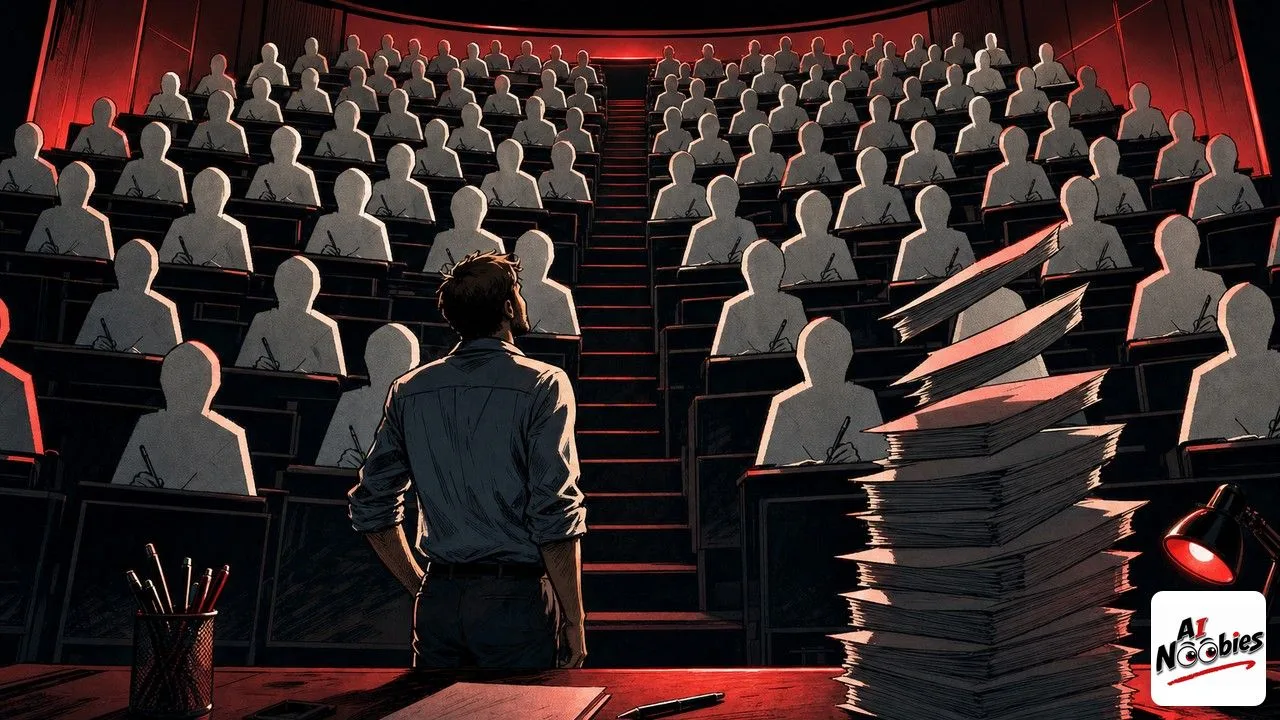
Scammers are signing fake students up for classes at US community colleges, then letting AI do the coursework so the money keeps arriving. The people who noticed first were not fraud investigators but history teachers, staring at a class list that did not look like their campus.
The Gist
- Fraudsters enrol students who do not exist, collect their financial aid, and hand the assignments to an AI.
- A professor at East Los Angeles College spotted the pattern from the names on his roster.
- Online courses with no fixed class time are the easiest to abuse, because nobody ever sees a face.
- One history teacher estimates more than half his students now use AI on their papers.
Have ChatGPT Recap This Article
ChatGPTMeet the student who enrolled but never existed
Community colleges in the United States are public two-year schools, and most of their students qualify for financial aid, which is government money paid to help cover tuition and living costs. That money follows enrolment. Sign up, stay enrolled, and the payment lands.
That is the whole opening. Scammers create fake students, enrol them in classes, and collect the aid meant for someone real. The one thing standing in their way used to be the coursework, because a fake student who submits nothing gets dropped from the class.
A chatbot solves that. Essays, discussion posts, short answers, all of it can be produced in minutes and pasted in on time. The fake student now has homework, which is exactly what the system was checking for. It is the same machine that is already reshaping what schools even teach, from grading policies to the 12,000 college majors China cut in one sweep.
How a history roster gave the scheme away
Professor David Song, who teaches at East Los Angeles College, noticed something years ago that no software flagged. His course was filling up with generic Anglo-Saxon names, on a campus whose student body is predominantly Latino and Asian.
The stories attached to those names did not hold either. They claimed prior coursework in Asian American topics that did not line up with anything else in their record. A teacher who knows his own campus can see that in a glance. A database cannot.
Song is not hostile to AI in his classroom. He allows it, on the condition that students label what they used it for and stay honest about it. What he flags is that even when the submitted work is blatantly machine written, the labelling rule simply does not get followed. That line between declaring your tools and hiding them is the whole thing, and there is a workable way to study with AI that stays on the right side of it.
Keep learning on AI Noobies:
- Taskade Free Plan Runs Out Faster Than You Think
- NextSlide Joins OpenAI to Make Your Presentations
- AI Agent Power Use Equals 600 Chat Prompts
What an asynchronous course is, and why it is the soft spot
An asynchronous course is one with no fixed meeting time. There is no video call at 10am, no roll call, no room. You get materials, deadlines and an upload box, and you work whenever you want.
For a working parent or a night-shift worker, that flexibility is the reason the degree is possible at all. For a fraudster, it is the reason the scheme works: the student is never seen, never heard, and exists only as text in a submission window.
That is why this format takes the hit first, and why fake students cluster there rather than in classes that meet on camera. Anonymity is the feature and the vulnerability at the same time, and no amount of essay-grading fixes it, because the essays are the part the AI is best at. One university saw grades collapse from 96% to 48% once students had to work without it, which shows how much of the visible performance was ever theirs.
How to see this in your own classroom or inbox
The honest reason this is hard to police is volume. Professor David Roach estimates that more than half his students use AI on their papers, and he asks a question worth sitting with: was it always true that half of us would cheat if it were easy enough?
If you are studying, the practical takeaway is that the line is about disclosure, not tools. Using AI to plan an essay and saying so is a different act from letting it write the essay and staying quiet, and only one of the two survives contact with an honesty policy.
If you are teaching, or paying for someone’s tuition, the thing to watch is what happens when the AI is taken away. A student who can still argue a point on paper without it has learned something. One who cannot has bought a transcript.
Zooming out, this story belongs to a bigger argument about what a diploma certifies now, and about who is even sitting behind the screen. Expect to hear more about verifying who a student is, and less about detecting what they wrote.
Stay tuned on AI Noobies.
About the Author