China’s Ministry of Education has shut down 12,200 university degree programs over four years and built 10,200 new ones in their place. The new majors are all built around AI, robotics and semiconductors, and the move arrives as 12.7 million young Chinese enter a job market that already runs above 16% youth unemployment.
The Gist
- 12,200 college majors closed in China between 2021 and 2025
- 10,200 new majors created in AI, robotics and semiconductors
- 9 universities now offer “embodied intelligence” degrees
What China actually did
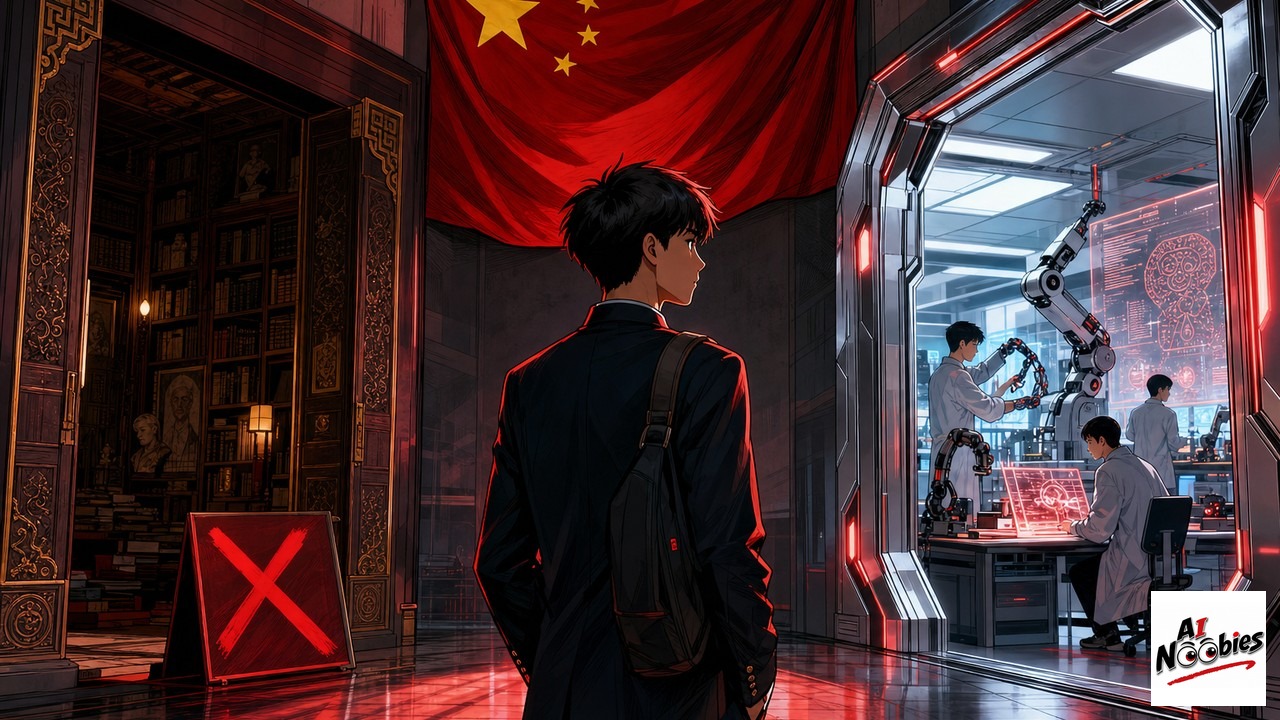
Between 2021 and 2025, China’s central education ministry revoked or suspended 12,200 undergraduate degree programs across its university network. The figures come from Ministry of Education data relayed by Xinhua, the Chinese state news agency.
On the same timeline, the same ministry approved 10,200 new degree programs to replace them. The arithmetic adds up to a net loss in choice, but a brutal pivot in direction. More than 30% of the country’s academic offering has been rotated in four years.
The cuts focus on four families of disciplines: arts, humanities, foreign languages and management. These are the programs the ministry calls obsolete, meaning their graduates struggle to find work in the current economy.
No other major higher education system has moved this fast. The move is centrally driven, meaning it applies uniformly across universities. Beijing is not asking, it is reshaping the academic map by decree.
What the new majors look like
The new programs cluster around tightly chosen fields. Artificial intelligence, robotics, semiconductor engineering, machine learning, data science and manufacturing automation dominate the new offering. These are the skills China bets its industrial future on.
Nine universities go a step further with “embodied intelligence” majors. Embodied intelligence means AI in physical systems, which translates into robots that move, sense, and act. It is the discipline that prepares engineers for autonomous machines, not for chatbots.
The pattern is consistent. The new programs prepare students for building, deploying and operating AI systems, not for studying them in theory. This is a workforce push, not a research push.
It also says something about the next five years. If the strategy holds, China will graduate millions of young people directly trained in AI and robotics, while most Western universities are still debating which AI topic to add to their syllabus.
Keep learning on AI Noobies:
- 79% of parents now use AI to raise their kids
- Americans AI optimism collapses: only 16% left
- OpenAI spending hits $34B: the year’s wild bill
What this means for everyone else
In the short term, the move sends a tough signal to Chinese students currently enrolled in the closed programs. They are caught with diplomas that the state itself just deemed less valuable. Their degrees are not erased, but the job market they were trained for is fading.
In the medium term, it puts a quiet pressure on every other country. If China builds AI-fluent graduates by the million, the talent gap with the West widens fast. Companies that hire globally are already watching, because the cost differential becomes harder to ignore.
For young people in any country, the read is sharper than usual. A government openly says that arts, humanities, foreign languages and management produce too many graduates for the economy it wants to build. That conclusion was always implicit, but rarely spoken out loud at this scale.
The takeaway is not that humanities are useless. It is that states are starting to make hard calls on which skills to fund, and AI sits on the winning side of that line. The choice of major just became more political, in China and everywhere else.
Follow the story on AI Noobies.
About the Author