Signal is the messaging app that prides itself on keeping your conversations private. Its boss Meredith Whittaker just told Bloomberg that AI chatbots are not your friends, not conscious, and definitely not safe to trust with everything. The example she picked apart might be the most useful explanation of what these tools actually want from you.
The Gist
- Signal’s CEO publicly warns that chatbots have no consciousness and no friendship to offer.
- She broke down how Microsoft Copilot asks for access to almost everything you own digitally.
- Her real concern is what happens when one assistant can read your messages, your card and your calendar at once.
Have ChatGPT Recap This Article
ChatGPTMeet Meredith Whittaker, the Signal CEO drawing the line
Meredith Whittaker is the president of Signal. Signal is a messaging app a lot like WhatsApp, with one big difference: it’s run by a non-profit and built around privacy. It promises that nobody, not even Signal itself, can read what you send.
In a Bloomberg interview, Whittaker delivered a line that sounded almost like a parental reminder. “These are not your friends. These are not conscious beings. These are not sentient interlocutors.” She was talking about every AI chatbot you can think of.
Why does it matter coming from her? Because Signal’s whole job is to protect what you write to people. If the Signal CEO is uncomfortable with AI chatbots, it’s worth paying attention. She is not somebody who spends her day fearing tech. She runs tech.
She also shared a small confession about her own use. She uses AI tools “to format a document here and there.” Nothing more. She doesn’t ask the chatbot to think for her. She doesn’t want her own thinking to be “foreclosed or eclipsed by the response of a system”. In plain words: she doesn’t want to outsource her brain.
The Christmas Shopping Example That Says a Lot
The most concrete part of the interview was about Microsoft Copilot. Copilot is Microsoft’s AI assistant. It lives inside Windows, Outlook and other Office tools. The example Microsoft has been showcasing is that Copilot can handle your holiday shopping for you.
It sounds friendly. The chatbot reads your family chats, figures out who likes what, picks the right gifts and places the orders. You stay on the couch. That’s the version Microsoft wants you to imagine.
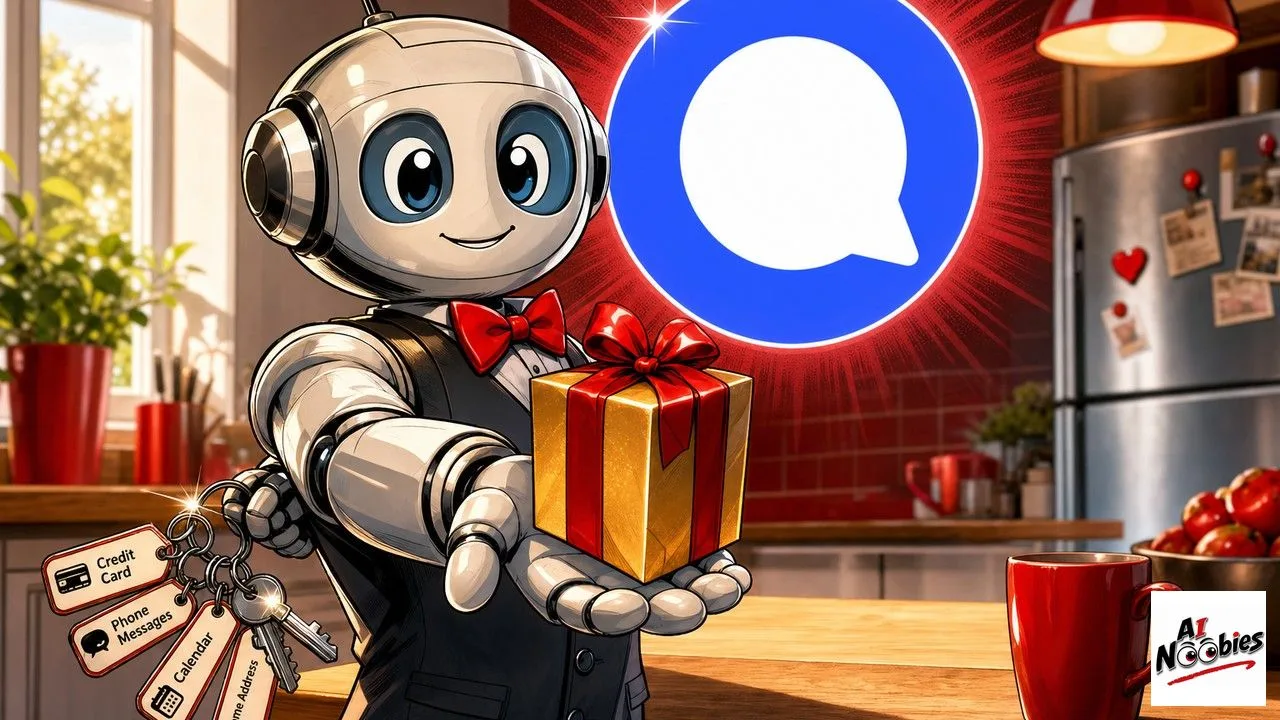
Whittaker stopped at that demo and listed what such a chatbot actually needs to do its job. Her own words. The credit card, the browser, the Signal app, the ability to send messages to her siblings on her behalf, her home address and her calendar.
Read that list again slowly. It’s not a one-time look at one app. It’s full access to your bank card, your browsing history, your private messages, your contacts and your schedule. The friendly assistant is, behind the scenes, holding the keys to almost every part of your digital life.
Whittaker called this setup “a kind of a backdoor.” A backdoor is a hidden way in. Even if your messaging app is protected, an AI assistant that’s allowed to read inside the app makes the protection pointless. The lock on the front door doesn’t help if you handed someone a copy of your keys.
Keep learning on AI Noobies:
- AI Chatbot News: 1 in 10 Use Them, Trust Lags
- China just cut 12,000 college majors because of AI
- 79% of parents now use AI to raise their kids
How to say no to the permission popups this holiday
In the next few weeks, expect to see more AI assistants asking for these kinds of permissions when you install or update something. Holiday season is around the corner and the shopping pitch is exactly what Microsoft and others want to show off. The next time a popup says “let your assistant access your messages to find the perfect gift,” remember what Whittaker said.
Within a few months, the conversation around AI tools is shifting. People used to ask “does the chatbot give good answers?” Now they’re starting to ask “what else is it allowed to do while I’m not looking?” Trust is the question, not skill. A recent Reuters study showed how shaky trust in AI chatbots already is.
Practically, here’s what changes for a beginner. When you set up an AI feature, the permission screens really matter. You don’t have to say no to everything, but you can say no to most things and still get the helpful parts. The chatbot that just formats a document doesn’t need to read your messages.
Whittaker’s stance also pushes other apps to do the same. Signal is likely to make it harder for outside assistants to peek inside its messages. Other apps that care about privacy will follow. The market is starting to reward “your data stays here” almost as much as “the AI is fast.”
If you take away one thing, take away the reminder behind the headline. The chatbot that calls you by your first name and answers in seconds is still software. It doesn’t worry about you, it doesn’t miss you, it doesn’t keep your secrets out of habit. It does what its owner tells it to do. Whittaker is asking you to remember who that owner is.
Follow the story on AI Noobies.
About the Author