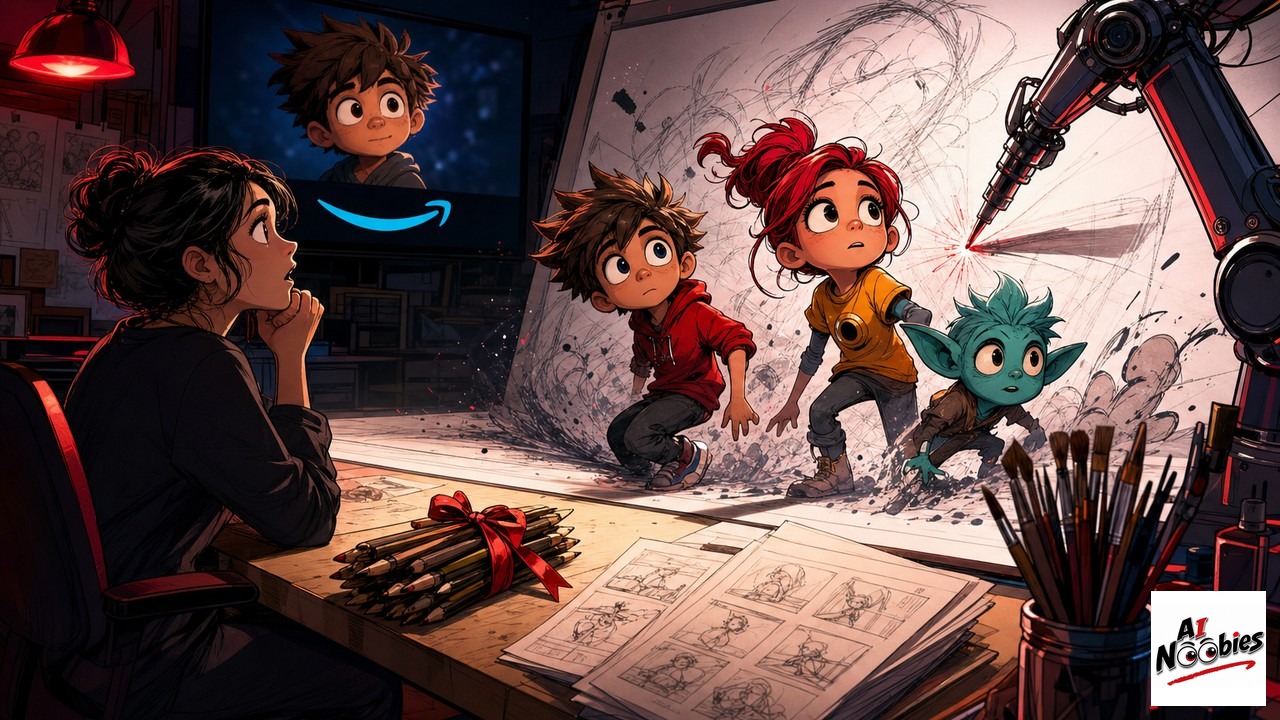
Amazon just greenlit three animated series for Prime Video made almost entirely by AI. The platform behind them is called Project Nara, and it completed its first pilots in five weeks. This is not an experiment. It is a fully operational production system built inside AWS.
The Gist
- Amazon’s Project Nara is an AWS-based AI platform that connects to professional animation tools like Blender, Maya, and Unreal Engine
- Three AI-animated series have been greenlit for Prime Video, with pilots produced in five-week timelines
- The platform is model-agnostic and uses in-house models trained on MGM’s intellectual property library
What Project Nara Actually Does
Project Nara is Amazon’s internal AI production platform, built on AWS. Think of it as a control center that connects AI systems to the same professional tools that real animation studios use every day: Blender, Maya, Nuke, Unreal Engine, and the Adobe Suite.
The platform does not rely on a single AI model. Instead, it routes each task to whichever AI tool is best suited for it. One model handles background design, another handles character movement, another handles lighting. The whole process is orchestrated from a single interface, without the animator having to switch between systems.
A key part of Project Nara is that it uses in-house AI models trained specifically on MGM’s intellectual property library. MGM, which Amazon acquired in 2022, owns thousands of films and series. Training AI models on that archive means the platform can generate characters, environments, and visual styles that stay consistent across an entire production, something generic AI tools struggle with.
Albert Cheng, Head of AI Studios at Amazon MGM, described the goal clearly: turning AI models into usable tools for the industry, not replacing creators but removing the friction that slows them down. AWS has stated it now has what it calls the only end-to-end AI content creation ecosystem in the industry, from infrastructure to distribution.
Amazon also launched the GenAI Creators’ Fund alongside Project Nara. The fund finances AI-powered film projects, giving independent creators access to the platform to produce content faster and at lower cost than traditional animation pipelines allow.
The Problems It Actually Solves
If you have ever seen an AI-generated video where a character’s face changes between scenes, or where motion looks choppy and unnatural, you have seen the problems Project Nara is designed to fix. Traditional AI video generators are powerful but inconsistent. They do not “remember” what a character looked like in the previous shot.
Project Nara addresses this through what it calls provenance tracking. Every piece of content generated by the system is documented: which model made it, which source it was based on, and how it connects to the rest of the production. This creates a kind of memory for the project, so characters stay recognizable and scenes stay visually coherent.
The five-week pilot timeline is the clearest measure of what this system changes in practice. A traditional animated pilot typically takes months of development, storyboarding, character design, and voice work before a frame is rendered. Project Nara compresses that into weeks, not by cutting corners but by automating the most repetitive parts of the process.
The three series greenlit for Prime Video are the first real-world proof that this works at a publishable quality level. Amazon has not released the titles yet, but the decision to commission them for its flagship streaming service signals that internal quality standards have been met.
What This Means for You as a Viewer (and a Creator)
For viewers, the most immediate effect is more content. Studios have always been limited by how long and how expensive animation production is. If AI can cut production time from months to weeks, platforms like Prime Video can commission far more projects, including ones that would have been too risky or too small-budget to greenlight before.
For creators and independent animators, Project Nara is a double signal. On one hand, tools that used to require a full studio team are becoming accessible to smaller teams or individuals. On the other, the giants are building proprietary pipelines that give them a production speed advantage that is difficult to match.
The medium-term question is what happens to mid-sized animation studios. Not the big ones with the resources to build their own AI systems, and not independent creators who can now use accessible tools. The studios in between, the ones doing solid professional work on standard budgets, are the ones most likely to feel the squeeze as production costs fall across the industry.
What is clear is that AI-made content on major streaming platforms is no longer a future scenario. It is happening right now, on Prime Video, produced in five weeks, by a system trained on decades of Hollywood history. The entertainment industry has changed faster than most people expected. Project Nara is the most visible proof of it so far.
Follow the story on AI Noobies.
About the Author