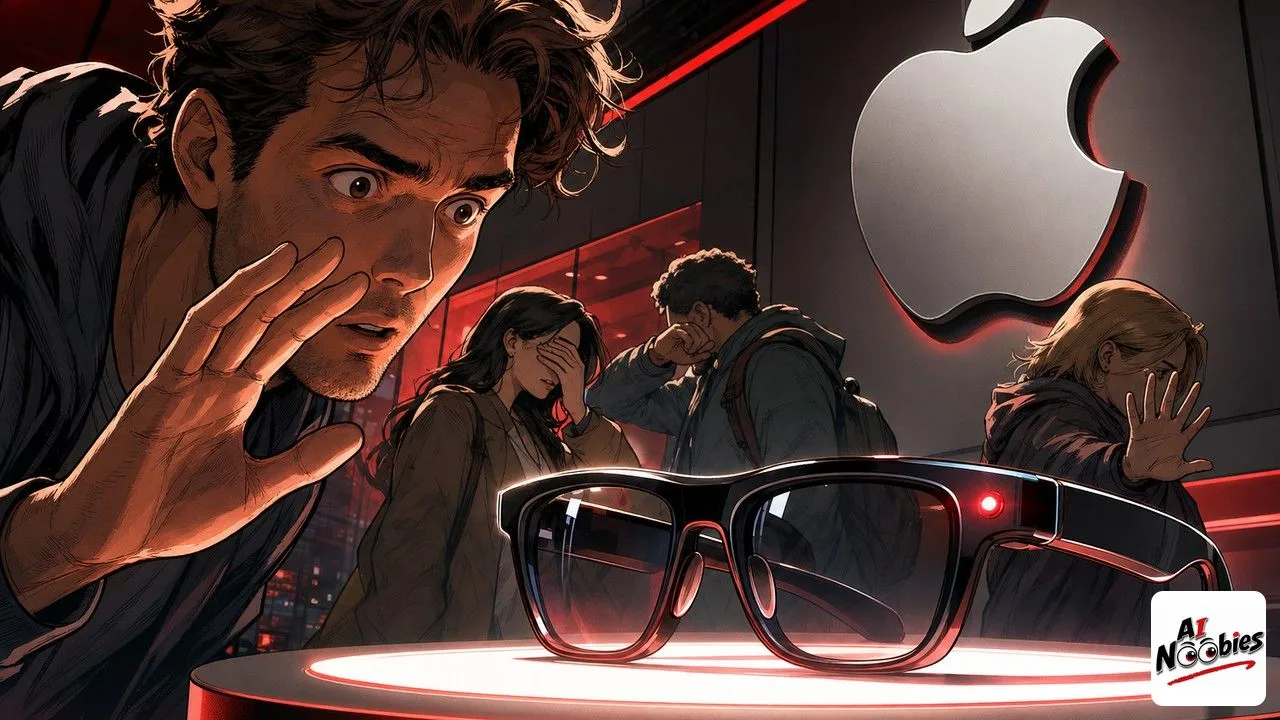
Apple is reportedly holding back its first smart glasses, which are eyeglasses with a tiny camera and AI built in, because it worries about people’s privacy. That delay means the gadget that could film the world around you likely will not reach shops before the end of 2027.
The Gist
- Apple is reportedly pushing its smart glasses to late 2027, and privacy fears are the newest reason for the wait.
- The camera could work three ways: recording with new limits, a camera that only feeds the AI with no saving, or no camera at all.
- Nothing here is official. Every detail comes from a single report, and Apple has confirmed none of it.
Have ChatGPT Recap This Article
ChatGPTMeet Apple’s smart glasses, in plain words
Smart glasses look like normal eyeglasses, but they carry a small camera and a computer chip that runs AI. The idea is that you could ask a voice assistant about whatever you are looking at, and it would answer through tiny speakers near your ears. Apple has reportedly been working on a pair like this for years.
According to reports, Apple now plans to reveal the glasses at its big event in June 2027 and put them on sale by the end of that same year. That is later than earlier chatter had suggested. It is worth saying plainly that Apple itself has not announced any of this.
The AI part is what makes these glasses interesting. Apple reportedly calls the brain behind them Visual Intelligence, a system meant to read what the camera sees and help you make sense of it. Back in May 2026, reports blamed the delay on this AI not being ready. Apple is also rebuilding its assistant Siri, so much of its AI work is moving at once.
How the tiny camera would work
A camera on your face is powerful and a little unsettling. In the reported plan, that camera would mostly exist to show the AI what you see, so it can name a plant, read a sign, or explain a menu in another language. The point is help in the moment, not a scrapbook of everyone who walks past you.
Here a key term matters. Apple reportedly wants the glasses to work on-device, which means the pictures are processed right on the phone or the glasses themselves instead of being shipped off to a company server. In simple terms, what the camera sees would stay with you rather than travel to a data center somewhere.
Reports add that Apple would not use face recognition, would not train its AI on your recordings, and would not have human contractors watch your footage. That last point fits the wider story of Apple’s bigger AI push. None of it is confirmed, so treat every promise here as a reported intention, not a done deal.
Keep learning on AI Noobies:
- RAM Shortage Is Making Your Next Phone Cost More
- Gemini Daily Brief Reads Your Inbox Each Morning
- OpenAI Pushed to Explain the AI That Broke In
What Apple is reportedly doing about privacy
Inside Apple, teams reportedly treat privacy as the “number one priority” for this product. Reports describe three camera options being tested. One keeps the camera but wraps it in new privacy limits. Another lets the camera only feed Siri and Apple Intelligence what it sees, with no way to record, save, or share any image. A third version drops the camera entirely.
There is also an anti-tampering idea. A smart-glasses camera normally shows a small light when it is recording, so people nearby can tell. Apple reportedly wants recording to shut off on its own if someone covers or messes with that little light, which would make it far harder to film people in secret.
Why so cautious? Apple is reportedly watching how Meta’s Ray-Ban glasses, already on sale, handle the same problem. Those glasses have been criticized for letting wearers record strangers without asking, and they picked up the nickname “pervert glasses,” with a privacy class action in the background. This is the exact mess Apple wants to avoid, and it helps to know how Meta handles user data.
Where to look before anyone films you
If you are worried about a stranger recording you, that exact fear is what is reportedly slowing Apple down. On glasses like these, a small indicator light usually turns on while the camera is rolling. When you meet someone wearing camera glasses today, that light near the lens is the tell to glance at.
The safeguards Apple is reportedly weighing are meant to make that even safer. A light that switches on during recording, a camera that cuts off if you try to hide that light, maybe no camera at all, and pictures kept on the device rather than uploaded. Taken together, these are answers to one plain question: is a stranger filming me?
Meta’s glasses are the ones on shelves right now, so they are the realistic thing to notice on the street this year. Apple’s version is still a reported plan, leaning on the company’s long-standing privacy image to stand apart from Meta. That reputation is a promise, not proof, until a real product ships.
The honest bottom line is that nothing here is confirmed. Every detail traces back to a single report, Apple has not spoken, and even in the best case these glasses would not arrive before late 2027. Stay tuned on AI Noobies.
About the Author