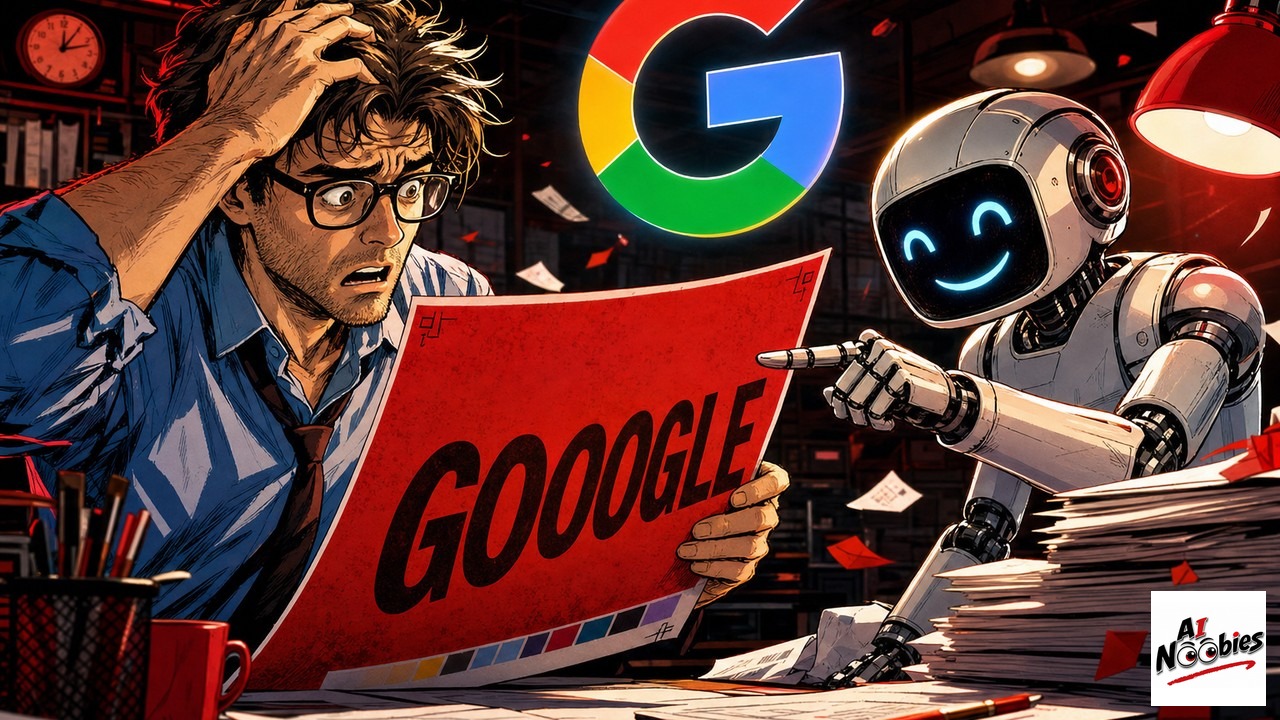
Google AI Overview recently spelled “Google” with two P’s. It counted one “r” in the word “poop.” It wrote “journalism” as “j-o-u-r-n-a-d-i-s-m.” These aren’t random bugs. They point to something fundamental about how AI tools actually work, and what that means for you every time you use one.
The Gist
- Google AI Overview made multiple public spelling errors, including misspelling its own company name as “Gooogle.”
- AI tools don’t read letter by letter. They work with chunks called tokens, which makes spelling genuinely difficult.
- Experts say the problem may never be fully solved, but it doesn’t stop AI from being useful for most tasks.
The Mistakes That Broke the Internet
When screenshots of Google AI Overview misspelling “Google” as “Gooogle” started circulating online, the reaction was immediate. People found it funny. Some found it alarming. All of them had the same question: how does the world’s most powerful search engine fail at something this basic? For context, see our earlier piece on AI Noobies: Google Dreambeans Turns Your Life Into a Cartoon.
The examples kept coming. In a live test, Google AI Overview was asked to count the number of R’s in the word “poop.” It replied with confidence: exactly one. It spelled “journalism” out loud as “j-o-u-r-n-a-d-i-s-m.” It produced the US president’s surname as “t-r-p-u-m.” Not vague answers. Not close calls. Completely wrong, stated with full certainty.
Google responded with a brief acknowledgment: “Counting within words has been a known challenge for LLMs, and we’re working to fix this particular issue.” No timeline was given. The phrase “known challenge” is the part worth paying attention to: it signals this isn’t a surprise to anyone inside the company.
This isn’t Google AI’s first public stumble. Earlier incidents involved AI Overviews citing satirical posts from The Onion and advice from Reddit threads, including a suggestion to eat rocks to get the minerals missing from a modern diet. Each episode landed differently, but they all come back to the same underlying tension: AI tools are being integrated into everyday search before they’re fully reliable.
Spelling errors feel different from factual errors, though. If an AI gets a date wrong or misunderstands a nuanced question, that’s understandable. But spelling “Google” wrong, as Google’s own AI, is the kind of failure that makes people question everything else the tool produces.
Why AI Tools Can’t Actually Read Letter by Letter
To understand why this happens, you need to know one thing about how AI works under the hood. When you read a word, your brain processes individual letters. AI tools don’t. They process text in chunks called tokens. That single difference explains almost everything.
A token is a piece of text that an AI model treats as a single unit. It could be a full word, part of a word, or a few characters. The word “journalism” might get broken up as “journal” and “ism.” The word “poop” might be stored as a single token, which means the model has no way of counting how many times a specific letter appears inside it. It has never actually “seen” the individual letters at all.
AI researcher Matthew Guzdial explained it directly: “LLMs are based on transformer architecture, which notably is not actually reading text.” The model predicts the next token based on patterns learned from billions of examples. It doesn’t spell from first principles. It guesses what a spelled-out word should look like based on how it has seen spelling done before.
Researcher Sheridan Feucht added that building a “perfect tokenizer” (one that would fix the spelling problem at the foundation) may simply be impossible. Language is messy. The same character can mean different things depending on context, and no clean universal rule covers every case.
The reason it hasn’t been fixed is also partly a priority issue. Spelling isn’t what a language model is primarily built to do. Understanding and generating meaning is. Engineers work around the spelling gap rather than solving it at the core, because the core is not where the main value lives.
What This Tells You About Using AI Tools Smarter
None of this means you should stop using Google AI, ChatGPT, Claude, or any other AI tool. What it does mean is that understanding their limits helps you use them better. That’s actually a skill worth developing.
AI tools are genuinely strong at tasks that involve meaning: drafting text, summarizing a document, explaining a concept in simple terms, generating ideas, rewriting sentences. These are tasks where pattern-matching over billions of words gives real results. But the moment you need character-level precision (spelling, counting letters, verifying an exact sequence), you’re asking the wrong tool.
If you’re using Google AI Overview to double-check a spelling, add a quick manual check on the side. The same goes for any AI assistant. These tools don’t proofread the way a spell checker does. They predict, and prediction sometimes fails at the edges.
Over the next few months, Google and other companies are expected to work on hybrid systems that combine traditional rule-based spell checking with AI generation. Some teams are already exploring targeted fixes to the tokenization process. But as of today, no clean solution exists, and the timeline for one is genuinely unclear.
Knowing this doesn’t make you a tech expert. It makes you a better user. Understanding that AI reads in chunks rather than individual letters is the kind of insight that takes two minutes to learn and saves you from trusting a tool in exactly the situations where it’s most likely to let you down.
Follow the story on AI Noobies.
About the Author