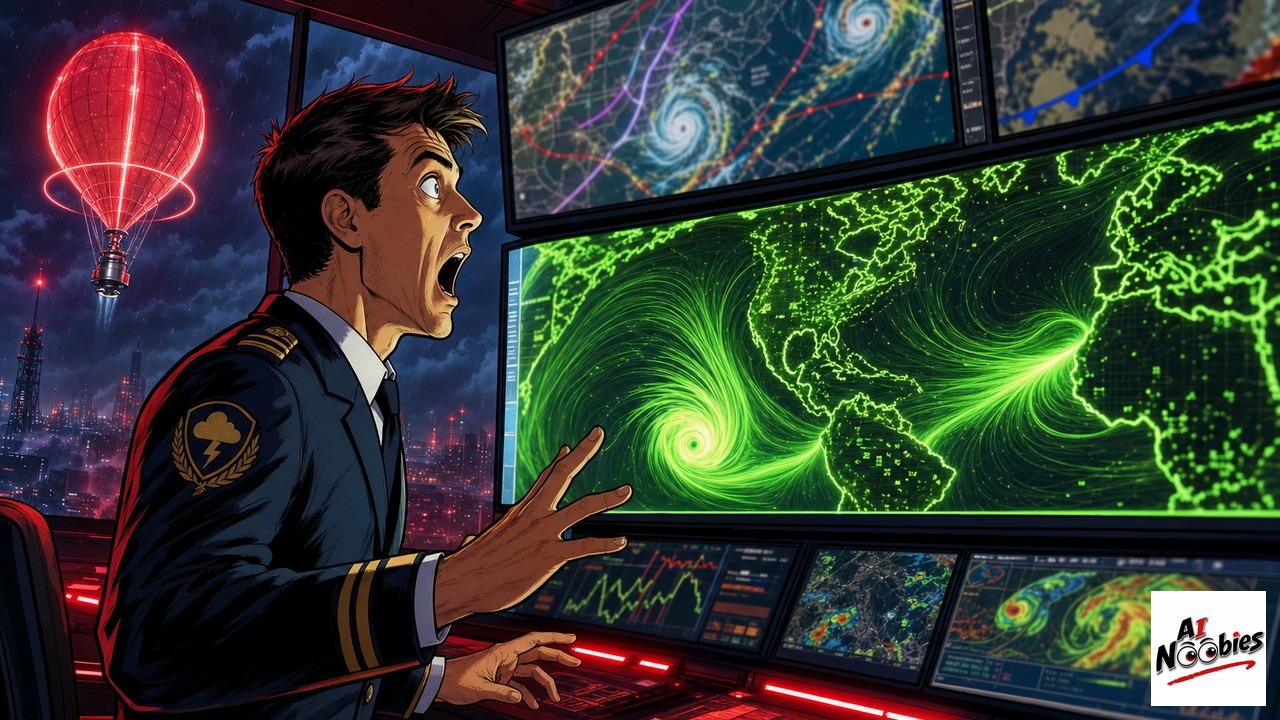
A small startup launched by Stanford students is now producing weather forecasts more accurate than the world’s leading meteorological agencies. WindBorne’s AI model WeatherMesh-6 is outperforming forecasters who have been doing this for decades. And it’s doing it with balloons.
The Gist
- WindBorne’s WeatherMesh-6 AI outperforms the ECMWF, considered the world’s best traditional weather forecaster
- The model provides hourly forecasts at 3 km resolution, far more precise than traditional 6-hour updates
- The company was founded in 2019 by Stanford students and has raised $25 million in funding
Balloons, AI, and a Better Forecast
Weather forecasting is one of humanity’s oldest scientific challenges. The best weather agencies in the world use massive supercomputers, thousands of ground sensors, satellites, and decades of accumulated data to predict what the atmosphere will do next. The European Centre for Medium-Range Weather Forecasts (ECMWF) is widely considered the global gold standard for this work.
WindBorne, a startup founded in 2019 by Stanford students, is now consistently beating that standard. The company uses about 400 specialized weather balloons in the air at any given moment, launched from 15 locations around the world. These balloons continuously collect atmospheric sensor data (temperature, pressure, humidity, wind speed) at altitudes where traditional ground sensors can’t reach.
That data feeds directly into WeatherMesh-6, WindBorne’s AI forecasting model. WeatherMesh-6 is a “transformer-based model.” It uses the same underlying technology that powers ChatGPT, but trained on atmospheric physics instead of text. The AI learns the patterns of how weather systems behave and evolve, then uses that knowledge to predict what comes next.
The results are striking. WeatherMesh-6 is “as accurate five days out as a traditional forecast is the day before.” In other words, what the best human forecasters can tell you about tomorrow’s weather, WindBorne’s AI can tell you about the weather five days from now, with the same level of confidence. That’s not an incremental improvement. It’s a different category of performance.
More Accurate, More Often, at Higher Resolution
The accuracy gap isn’t the only advantage. Traditional weather agencies typically update their forecasts every six hours. WindBorne’s WeatherMesh-6 produces hourly forecasts. That means instead of getting a snapshot of expected weather four times a day, you’d potentially get 24 updates, each one more precise than the last as real-world conditions are incorporated.
The geographic precision is also different. WeatherMesh-6 works at 3 km resolution across Europe and the United States. Traditional models often operate at 9 km or coarser resolution, meaning they average conditions across a wider area. A 3 km resolution model can distinguish weather patterns between your neighborhood and one a few miles away. That matters enormously for farmers, logistics companies, and emergency services.
WindBorne already sells its balloon-collected data to major government agencies: the National Oceanic and Atmospheric Administration (NOAA), the US Air Force, and the US Navy. It also provides forecast data to investors and commodity traders, for whom knowing about a storm three days early can be worth millions of dollars.
The company has raised $25 million in venture capital and was valued at $85 million as of 2024. For a startup competing directly with agencies backed by government budgets and decades of infrastructure, those are modest numbers, which makes the performance gap all the more remarkable.
What This Means for Regular People
Most of us check the weather app on our phone without thinking much about where that data comes from. Right now, those apps rely on data from national agencies. These are the same agencies WindBorne’s AI is outperforming. In the short term, the most likely change is that weather apps, flight planning tools, and agricultural platforms start integrating WindBorne’s data alongside or instead of traditional agency feeds.
For everyday users, more accurate forecasts mean fewer surprises. A barbecue that doesn’t get rained out. A flight that boards on time because the airline predicted the turbulence window correctly. Emergency services preparing for a storm 24 hours earlier than currently possible. The practical impact of better weather data touches almost every part of daily life.
Over the next three to six months, WindBorne is likely to face both competitive and regulatory pressure. Government weather agencies won’t simply concede their territory. They’ll likely integrate AI models of their own, and some may seek to acquire or partner with startups like WindBorne. The debate around privatizing critical weather infrastructure, and what that means for public access to forecasts, is just beginning.
The broader takeaway is worth sitting with. A startup with 400 balloons and an AI model built by Stanford graduates just outperformed some of the world’s best-resourced scientific institutions. Not in some niche benchmark, but in one of the most practically important predictions humans make every single day. This is what AI disruption actually looks like when it reaches your weather app.
Follow the story on AI Noobies.
About the Author