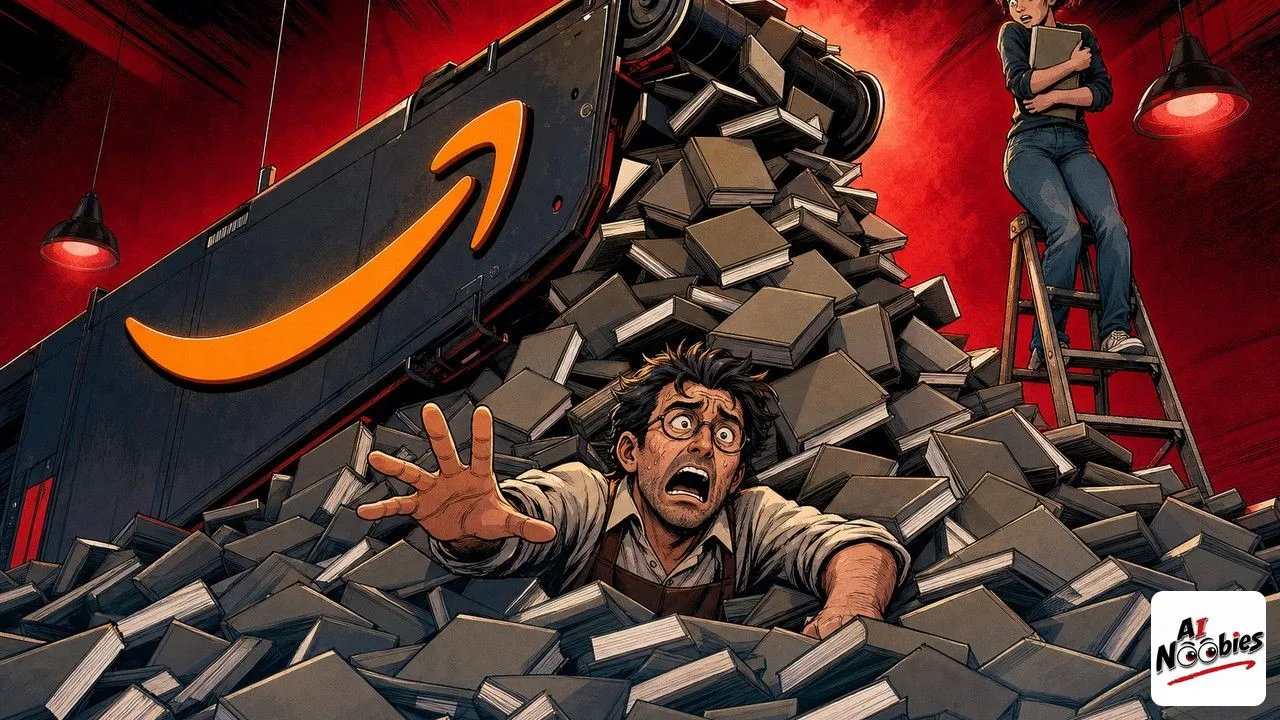
A new study went through more than 14,000 self-published titles on Amazon and found that AI books now make up one in five of them. If you buy ebooks, that changes the odds of what lands in your cart, and it changes what the human authors you like actually earn.
The Gist
- AI books are 20% of the self-published catalog studied, but only 12.1% of sales.
- The catalog grew 38 times over three years while total revenue grew fewer than 9 times.
- Revenue per book fell for human-written titles too, in seven genres out of eight.
- One AI author identity pulled in 1.7 million dollars across eight titles.
Have ChatGPT Recap This Article
ChatGPTMeet the study that counted 14,419 Amazon books
Researchers looked at 14,419 self-published ebooks on Amazon, covering January 2023 to March 2026. Self-published means the author uploaded the book directly, with no traditional publisher in between, which is how a very large share of ebooks reach the store today.
To decide which books were written with AI, they ran the text through a detector called Pangram, which the team reports at a 0.04% false-positive rate. In plain terms, that means the tool almost never accuses a human-written book of being machine-written, so the 20% figure is more likely to be an undercount than an exaggeration. You can read the full research paper describing the method and the sales data behind it.
The sales side came from a major US publisher that tracks around 500,000 Amazon titles. That matters because most conversations about AI books stop at how many exist. This one could also see what they earned.
How one fifth of the catalog ends up with one eighth of the sales
Here is the split that surprised people. Books with substantial AI content are 20% of the catalog, 12.1% of sales and 11.3% of revenue. Books with no AI content sit at 62.9% of the catalog and 72.5% of revenue.
So AI books are not winning on quality, and readers are not being fooled at scale. They are winning on volume, and volume is the whole point. When a machine can produce a finished manuscript in an afternoon, the limit on how many books exist stops being human effort.
The exceptions are loud, though. The highest-earning AI author identity in the data made 1.7 million dollars across eight titles, and a single AI book brought in 643,000 dollars on 80,431 copies sold. That said, those are outliers in a dataset where the average AI title sells poorly.
There is also a visibility effect. AI titles now account for 31% of new entries into the Top 25, which is the part of the store a casual buyer actually browses.
Keep learning on AI Noobies:
- Claude Watermark Detection Opens to Everyone
- ChatGPT for Linux Finally Gets Its Own App
- Spotify Will Tag AI Persona Artists in September
What dilution means in a store that never runs out of space
The researchers use a word worth learning here, and that word is dilution. It describes what happens when the number of products explodes faster than the number of buyers, so each product gets a thinner slice of the same pie.
The numbers show it clearly. Between early 2023 and early 2026, the catalog grew 38.3 times over, the count of titles selling each quarter grew 19.2 times, and total quarterly revenue grew only 8.9 times. More books, more of them selling something, and not much more money going around.
That is why revenue per book dropped in seven genres out of eight, including for books with no AI in them at all. A human author releasing the same quality of work in 2026 as in 2023 earns less, simply because there is more competition for the same attention. This is the same pattern already documented on social platforms, where AI-written posts have flooded LinkedIn and X without adding readers.
Platforms have started reacting, mostly with labels and reporting tools. LinkedIn went that route when it added a button to report low-effort AI content. Amazon caps how many titles one account can upload per day, but the study suggests the flow is arriving anyway.
How to spot an AI book before you pay for it
Start with the author page. A real author usually has a back catalog that took years to build, a website, interviews, sometimes a newsletter. Eight books published in four months under a name with no trace anywhere else is the clearest signal in the whole store.
Then use the free sample. Amazon lets you read the opening pages of almost any ebook before buying, and AI-written nonfiction tends to give itself away fast, with chapters that restate the title in different words and never reach a specific example, a date or a name.
Zooming out, the fight over who owns the text that trains these systems is far from settled. Anthropic ended up in the middle of it when it agreed to pay authors 3,000 dollars per pirated book. The bookstore case is the next chapter of that same argument, and it will land in the news you hear about jobs, copyright and what a professional writer is worth.
For now, the practical move is small and it works. Buy from author pages you recognise, use the sample, and treat a suspiciously deep catalog under an unknown name as a reason to keep scrolling.
Stay tuned on AI Noobies.
About the Author