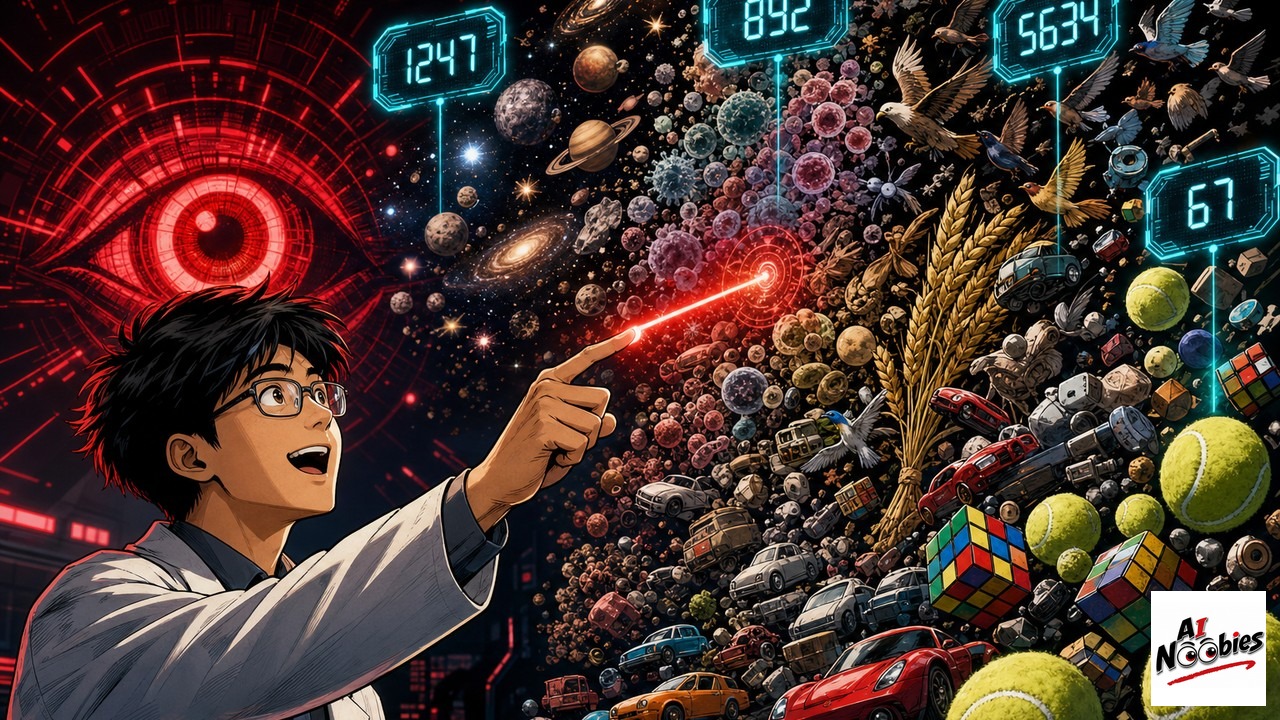
A new AI model named Count Anything can count almost anything in any picture, just by typing what you want it to find. It cuts the error rate in half compared to older counters. The code is public on GitHub.
The Gist
- Count Anything counts objects in any image from a simple text prompt
- The model misses by roughly 9 objects per category, half of what others do
- It works for medical scans, farm fields, traffic and satellite pictures
What “Count Anything” actually does
Count Anything is an AI model that does one thing very well. You give it an image and you type the name of whatever you want it to count. The model returns the number and shows you what it spotted on the picture. That is the entire interface.
The trick sounds easy. Counting people in a crowd, cars in a parking lot, or cells under a microscope is what humans do all the time. But for an AI, counting is one of the hardest tasks. Models built for spotting objects often miss the small ones, double-count the big ones, or freeze in front of dense scenes.
Count Anything fixes this by combining two methods in one. The first method draws a rectangle around every visible object. It works well for things you can see clearly, like cars or people standing apart. The second method places a dot on every single pixel that looks relevant. It works well for tiny stuff, like cells or grains.
The model then merges the two results without counting anything twice. It uses a confidence score to decide which method to trust on each part of the image. The result is a single number that holds up across very different scenes, from a farm field to a histology slide.
Where it came from and how it’s smarter than older counters
Count Anything was built by researchers at Tsinghua University in China, with help from other institutions. They started from Meta’s SAM3, which is a foundation model that already knows how to segment objects in pictures. Segmenting means drawing the outline of every object the model spots.
To train the new model, the team built a dataset called CLOC. It contains around 220,000 images and 15 million labeled objects across 619 categories. The pictures span six different fields. General scenes, satellite imagery, histopathology, cell microscopy, agriculture, and microbiology.
That mix is the key. Most older counters learn on one type of scene and break when you show them something else. A model trained on crowds will count cars badly. A model trained on cells will fail on traffic. Count Anything trained on all of these at once, so it stays usable when you change context.
The performance numbers back the claim. The model is off by about 9 objects per queried category on average. The closest competitors are wrong by more than double that. On crowd counting, Count Anything matches generalist tools but still loses to specialists trained on crowds only.
The researchers also flag honest limits. The model struggles when the prompt is vague, like asking it to count “stuff”. It also drops in accuracy when objects overlap heavily, which happens in very dense scenes. Counting is precise work, and the system is not magic.
Keep learning on AI Noobies:
- Google sues “Outsider Enterprise”, a $1.9B AI scam ring
- OpenAI Ohio data center: 10 GW with Nvidia behind it
- Deezer AI music detector flags Spotify and Apple too
Why this changes daily work for a lot of people
In the short term, the most direct impact will hit people whose job includes counting. Lab technicians, farmers, urban planners, retail managers, biology researchers, satellite analysts. All of them spend chunks of their week pointing at pictures and counting things by hand. That step can now be done in seconds.
For a medical lab, that means scanning a slide and getting a cell count before lunch instead of after. For a farmer, it means estimating the yield of a field by snapping a drone shot. For city teams, it means counting cars at an intersection without sending a person to sit there for a day.
The pattern matters even if you do not count things for a living. Count Anything is part of a wave of specialized models that solve one boring task very well. These tools are easy to add to existing software. Your favorite app could ship a “count what you see” button within the year.
In the medium term, the model will improve fast. The code is open source on GitHub, which means thousands of developers can fine-tune it on their own data. A version trained on warehouse boxes will be sharper for logistics. A version trained on coral reefs will be sharper for marine biology.
For everyday users, the takeaway is simple. AI is not just chatbots and image generators anymore. Quiet tools like Count Anything are popping up to handle the small jobs that nobody enjoys doing. You will use them without even noticing, the same way you use a calculator on your phone without thinking about it.
Follow the story on AI Noobies.
About the Author