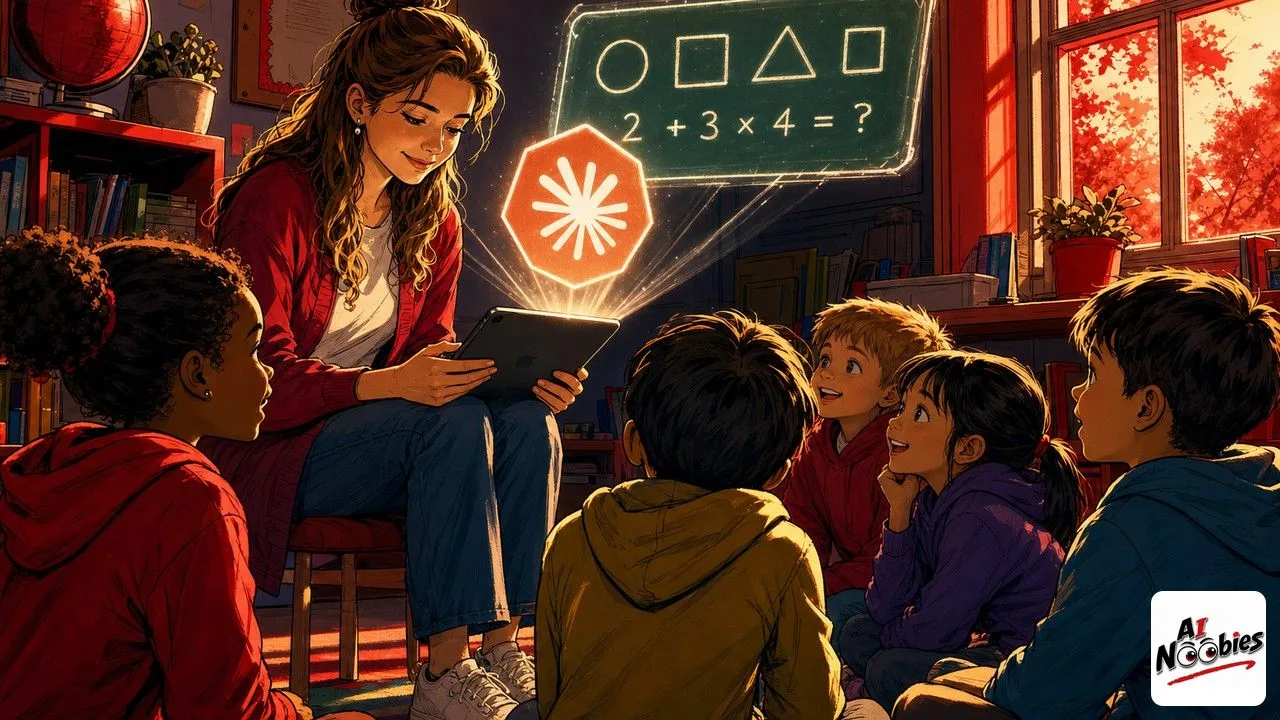
Anthropic just opened a program that gives every verified US K-12 teacher a full year of Claude Pro for free, plus a library of ready-made teaching tools and lesson plans tied to every state’s academic standards. If a teacher, a parent or a school leader in your family lives in the US, this is a change that will show up in classrooms starting this fall.
The Gist
- Claude for Teachers launched on July 14 and gives one full year of premium Claude for free to verified US K-12 teachers.
- Teachers also get a library of lesson tools and access to curricula mapped to every US state standard.
- Signup is open until June 30, 2027, and the program partners with the American Federation of Teachers, Teach for America, the Gates Foundation and Detroit Public Schools.
Have ChatGPT Recap This Article
ChatGPTMeet Claude for Teachers, in plain words
Claude is the AI chatbot built by Anthropic, in the same family as ChatGPT or Gemini. Claude Pro is the paid version of Claude that usually costs about twenty dollars a month, and it gives you more messages, longer conversations and access to the smarter versions of the model. Claude for Teachers gives all of that for free, for one year, to verified US K-12 teachers.
K-12 in the US means every school year from kindergarten to twelfth grade, so basically every teacher working with kids and teens up to eighteen. Anthropic walked through the whole program in its official launch post published Monday, alongside the list of partners and the signup deadline set at June 30, 2027.
To sign up, a teacher needs to verify they actually teach in a US K-12 school. Anthropic has not published every detail of the verification, but the usual model in ed-tech is a school email, an ID card, or a certification through partners like the American Federation of Teachers. Once verified, the account is upgraded to Claude Pro for free for the full year.
How the new teaching tools actually work in a classroom
The most important detail is that Claude for Teachers is not just Claude Pro for free. It ships a library of ready-made teaching skills, which are basically pre-built templates for the tasks a teacher does over and over: writing a lesson plan, adapting a worksheet for a struggling reader, drafting a note for a parent, reviewing exit tickets, building a rubric.
The lesson planning skill is aligned with each state’s academic standards. Anthropic built this alignment with a partner called Learning Commons, which keeps track of what fourth graders in Texas should learn about fractions and what seventh graders in Vermont should learn about the Civil War. When a teacher asks Claude to plan a lesson, the assistant pulls the right state standards automatically.
Another useful skill is differentiation. A teacher can ask Claude to take one exercise and rewrite it at three different reading levels for the same class. That is a task that used to eat an entire evening for a teacher who wanted to accommodate kids with different needs. Now it takes a few minutes inside the chat. The tool for class data analysis works the same way: paste the numbers, ask a question in plain English, get an answer without touching a spreadsheet.
Keep learning on AI Noobies:
- The New Siri Is Now Open to Every iPhone in the Beta
- ChatGPT for Grandparents: 4 Everyday Uses Worth Trying
- 16 Nobel Winners Ask the World to Prepare for AI
Why Anthropic teamed up with unions, districts and Gates
Ed-tech in the US is a landmine field politically. Teachers, unions and parents are cautious about who gets access to school data, which apps land on classroom laptops, and who decides what happens with AI-generated grades. Anthropic did something unusual and locked in partnerships with big institutional names from day one.
The American Federation of Teachers is one of the two big US teacher unions. It helped set the privacy rules for what Claude can and cannot do with student data. Teach for America is a nonprofit that puts new teachers into high-need schools, and it will co-create an AI fluency course for those teachers. Detroit Public Schools is the pilot district: a full school system that tries the program first before it opens wider.
The Gates Foundation is the partner on measuring impact. Ed-tech in the US has a long track record of promising better test scores and delivering little. By tying itself to Gates on outcome measurement from launch, Anthropic sets itself up to have real numbers to show at the end of the school year, rather than warm anecdotes and marketing videos.
Nine ed-tech tools are already integrated: ASSISTments, Brisk Teaching, Canva Education, Coteach, Diffit, Eedi, MagicSchool, Snorkl and TeachFX. If a teacher already uses Canva Education for classroom posters, they can pull Claude into that same workflow without switching apps. Zooming out, this connects to a bigger pattern: Anthropic recently said Claude gets used more for office work than for code, and teaching is exactly the kind of writing-heavy office job Claude is already good at.
How a US teacher or parent can try Claude for Teachers this week
If you teach in a US K-12 school, step one is to go to Anthropic’s official page for the Claude for Teachers program and click the signup button. Step two is the verification process: expect to be asked for a school email or a proof of employment. Step three, once verified, is to log into Claude and see the teacher features unlock inside the account, including the library of teaching skills.
Some first prompts that show off the teacher features in one minute: “plan a 45-minute lesson on fractions for a fourth-grade class in Texas”, “rewrite this worksheet for a student reading two grade levels below”, “draft a parent note explaining that Kevin is struggling with homework and needs extra support”, “give me a rubric to grade a short essay on the Civil War for eighth grade”. Each of these matches a real classroom moment.
If you are a parent instead of a teacher, this program still matters. Ask your kid’s teacher whether their school is enrolling. If yes, you may want to know how the school treats AI-drafted comments, feedback and grades, since Claude for Teachers can generate all of them. Anthropic and its union partner set privacy rules, but each district and each teacher makes the final call on what to use in class. This is also a good moment for parents to catch up on what AI assistants can and cannot do, and the guide on ChatGPT for grandparents on everyday tasks is a useful entry point for anyone who hasn’t tried a real conversation with an AI yet.
One last note. The Claude for Teachers program covers verified US K-12 teachers only, one full year of free Claude Pro, with a June 30, 2027 signup deadline. Higher education is not included in this specific program, and Anthropic has not published a version for teachers outside the US yet. Both of those doors may open later, especially if the pilot in Detroit and the outcomes work with Gates produce numbers Anthropic can point to.
Stay tuned on AI Noobies.
About the Author