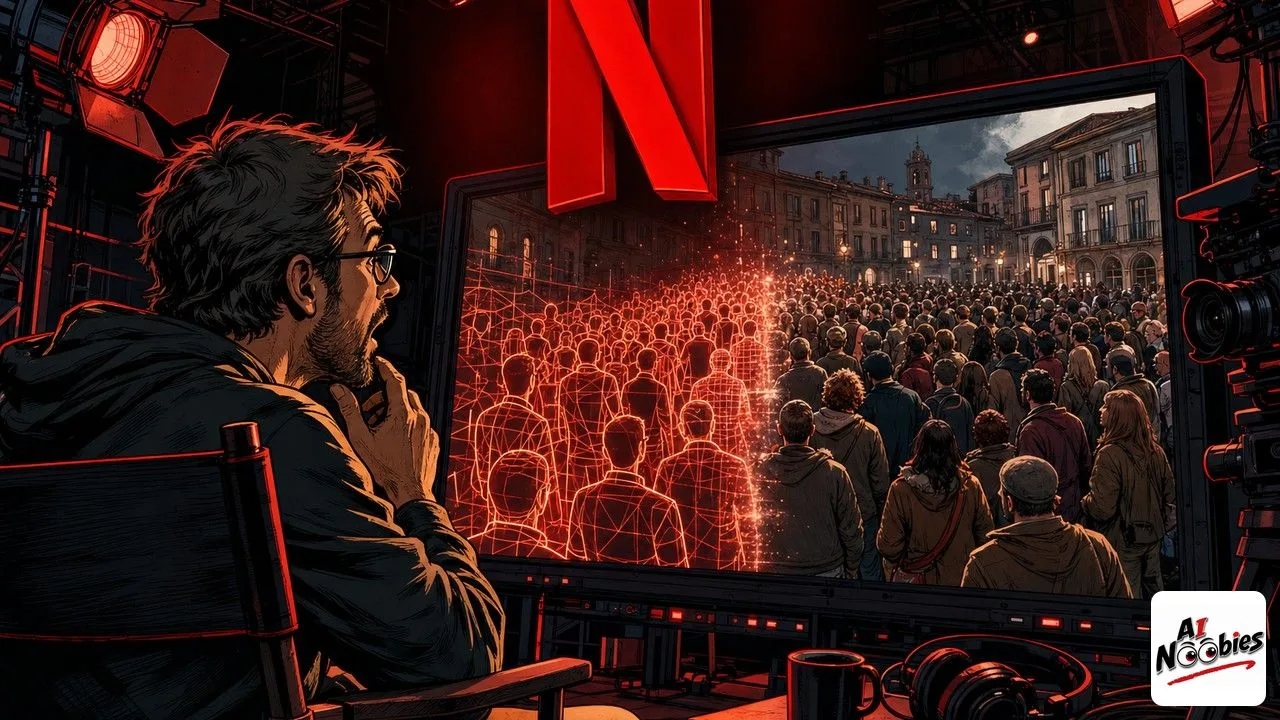
Netflix now uses AI in roughly 300 of its productions, mostly to help finish shows faster and cheaper rather than to write them. If you watch Netflix, this is the moment AI quietly moved from a buzzword into the movies and series already on your screen.
The Gist
- Netflix AI is used in about 300 productions, mainly in the later stages of making a show.
- One docuseries used 17 minutes of AI-assisted footage, made twice as fast and for half the cost.
- Netflix spends around $20 billion a year on content and says AI is a tool for artists, not a replacement.
Have ChatGPT Recap This Article
ChatGPTWhat Netflix Is Actually Doing With AI
The headline number is simple. Netflix AI now shows up in roughly 300 productions, and in most of them it works behind the scenes rather than on the page.
The clearest example is a docuseries called The American Experiment. It included 17 minutes of AI-assisted footage, and Netflix says that part was made twice as fast and at half the usual cost. The AI helped expand crowd scenes and rebuild historical battle sequences that would normally take a large team weeks.
Netflix chief Ted Sarandos framed it carefully. He said it takes great artists to make something great, and that AI will give creatives better tools rather than remove them. This fits the same pattern we saw when YouTube started labeling AI-made video: the tools are arriving inside the platforms you already use.
How AI Helps Make a Show, Step by Step
Making a show is not one job, it is many. There is the idea, the planning of each shot, the filming, and then the long cleanup at the end. AI is mostly helping with the planning and the cleanup, not the acting or the story.
Early on, AI can sketch what a scene might look like before anyone films it. Later, it can speed up the slow finishing work, like adding more people to a crowd or smoothing a special effect. That is where the time and money savings come from.
Netflix uses its own tools for this, including one built for visual effects and a small in-house animation lab. The point is that AI is stitched into steps that used to be done entirely by hand, which is exactly why it spreads so quietly.
Keep learning on AI Noobies:
- GPT-5.6 Deleted Some Users’ Files by Mistake
- Google AI Mode Now Does Tasks in Your Apps
- AI for Students: How to Use It Without Cheating
What Post-Production and VFX Really Mean
Two words come up a lot here, so it helps to know them. Post-production is everything that happens after filming: editing, sound, color, and cleanup, the stage where a raw scene becomes the finished thing you watch.
VFX, short for visual effects, is the art of adding things that were not really there, like a giant crowd, a storm, or an old city. These two stages are exactly where Netflix AI is doing the most work, because they are slow, detailed, and expensive.
This also explains why the debate is heating up. When a tool can do part of that skilled work faster, it changes who gets hired and for what, a tension you can also hear in how much online content is already written by AI.
Where You’ll Notice AI Next Time You Watch
You probably will not spot it directly, and that is the point. A crowd that looks a little bigger, a historical scene that feels fuller, an effect that would once have been too costly for a mid-size show, these are the quiet places AI is already sitting.
If you want to test your own eye, pick a recent Netflix documentary and watch the background during big scenes. You will start to notice which moments could have been expanded or rebuilt with AI, and it changes how you read what is on screen.
The bigger takeaway is calm, not scary. AI is becoming a normal part of how shows get made, much like editing software once did, and knowing that makes you a sharper viewer rather than a worried one.
Stay tuned on AI Noobies.
About the Author


2 thoughts on “Netflix AI Is Now Behind Around 300 Shows”