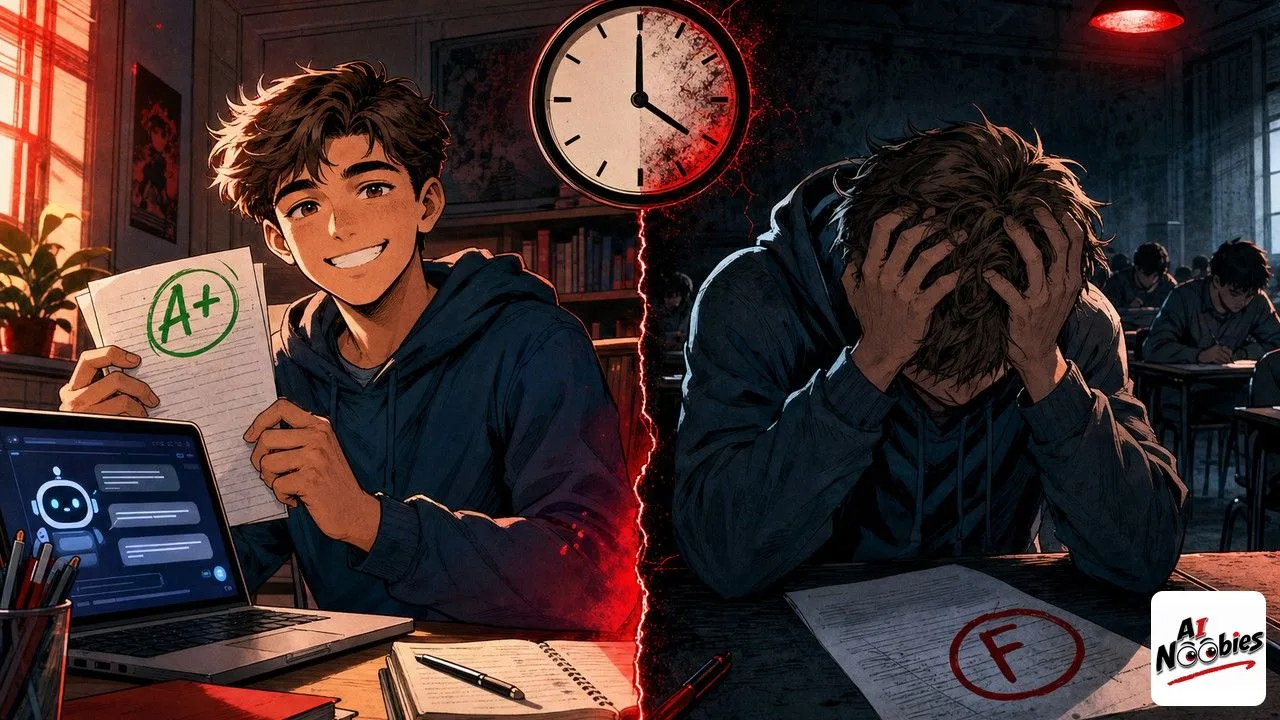
A giant study of 26,000+ Chinese teenagers just landed, and it says something uncomfortable. Homework With AI makes your grades on assignments jump right away. Two years later, the same students crash on the real exams by nearly a quarter of their score.
The Gist
- Homework scores went up 18% with AI help, and kids finished 19 minutes faster on average.
- Real in-person exam scores dropped 20% within 6 months, and the big entrance exams fell 18% to 24% two years later.
- The heaviest AI users are the ones who fall the hardest, and no student group is spared.
What The Study Actually Found
Researchers followed more than 26,000 secondary school students (Grades 7 to 12) in a county of over a million people in central China. They tracked 30 months of data, so this isn’t a snapshot. It’s a long look at what happens when kids get comfortable doing Homework With AI.
The kids used chatbots like Doubao, DeepSeek, ChatGLM, Ernie Bot and Qwen. Quick note: these are basically the Chinese versions of ChatGPT. Same idea, same feel, you type a question and get an answer. They used them the way a lot of students everywhere use ChatGPT today, to knock out assignments faster.
On the homework side, everything looked great. Scores climbed 18%. The time spent per homework session dropped from 64 minutes to 45 minutes. A parent seeing that would probably feel relieved. Finally, the kid is on top of things.
Then came the exams. On the monthly in-class tests, scores fell 20%. On the big entrance exams (the Zhongkao for middle school and the Gaokao for high school, the two make-or-break tests that decide which high school or university a Chinese student goes to), scores dropped between 18% and 24%. That’s a chasm between what the grade book showed and what the students actually knew.
And the damage isn’t small pockets of kids. Social sciences dropped 27%. STEM subjects like math and science dropped 22%. English dropped 17%. Even Chinese, their native language, dropped 9%. Younger students lost 24%, older ones 17%. Boys lost 21.6%, girls 18.4%. The strongest students lost 24%, the weaker ones 16%. Nobody comes out clean.
Why It Happens (And The Timeline You Need To See)
Here’s the mechanism, in plain words. When a kid does Homework With AI, they stop struggling. The struggle is exactly what builds the skill. You wrestle with a math problem for 20 minutes, you fail three times, and on the fourth attempt something clicks. If the chatbot hands you the answer in 90 seconds, that click never happens.
This shows up sharply in one number. 81% of kids who used AI for more than five months finished their homework in under 50 minutes, got great homework grades, and scored terribly on real exams. That’s the “prompt and copy” reflex. Read the question, paste it into the chatbot, copy the answer, done. The brain never touches the material.
The timeline matters too, and it’s a bit sneaky. It takes about 6 months for the drop to show up on monthly in-class exams. That’s when teachers first realize something is off. But the real crash, the one that hits entrance exams, needs closer to 2 years to fully appear. This is why the problem is hard to catch in real time.
Think about the parent watching their kid’s report card. Homework: 92. Test: 68. Six months in, you tell yourself the kid just gets nervous under pressure. A year in, you blame the teacher. Two years in, the entrance exam comes back and the score is 24% below what you were expecting. And by then it’s too late to fix. This same pattern, seen in China with education, echoes what came up in the recent overhaul of 12,000 Chinese college majors around AI, where the country is clearly ahead of everyone on measuring what AI does to learning.
One more thing worth naming. This isn’t about kids being lazy. It’s about a tool that removes the friction that used to build the muscle. If you never lift weights because the machine lifts them for you, your arms don’t get stronger. Same idea, but with reading, writing and thinking.
Keep learning on AI Noobies:
- How to Read a 100-Page PDF With ChatGPT in Minutes
- Copilot AutoPilot Explained: What AI Agents Really Do
- Claude vs ChatGPT vs Gemini: Which One for You?
What This Means For You, Your Kids, Or Students You Know
Short term, if you have a teenager doing Homework With AI, the fix isn’t to ban the chatbot. That never works and they’ll just do it in secret. The fix is to change how it’s used. Ask the kid to do the problem first, get stuck, write down what they tried, then use the AI to explain the concept they’re stuck on. The AI becomes a tutor, not a ghostwriter.
A simple test: can the kid explain the answer out loud, without the chatbot, five minutes after they finish? If yes, the AI helped them learn. If no, they just copied. This 30-second check at the dinner table catches most of the damage before it stacks up. Some parents are already thinking about this shift in role, and a huge 79% of parents now say they use AI to help raise their kids, which makes the “how” question urgent, not the “if”.
Medium term, this study is a preview of what happens in offices too. If you use AI to write every email, every report, every summary, for two years, the same thing will happen to you. You’ll look productive. Your output will look great. And when you’re pulled into a live meeting, or asked to think without your tools, you’ll notice a gap you can’t hide. The muscle atrophies quietly.
There’s a healthy way to keep using AI without becoming dependent. Do the first draft yourself, even a rough one. Then ask the AI to critique, improve, or reformulate. This way your brain does the thinking, and the AI does the polishing. It’s the opposite of the “prompt and copy” reflex, and it’s the difference between growing and shrinking. If you want a starting point on how to phrase your requests, writing a prompt that actually works is a good place to build the habit.
Stay tuned on AI Noobies.
About the Author