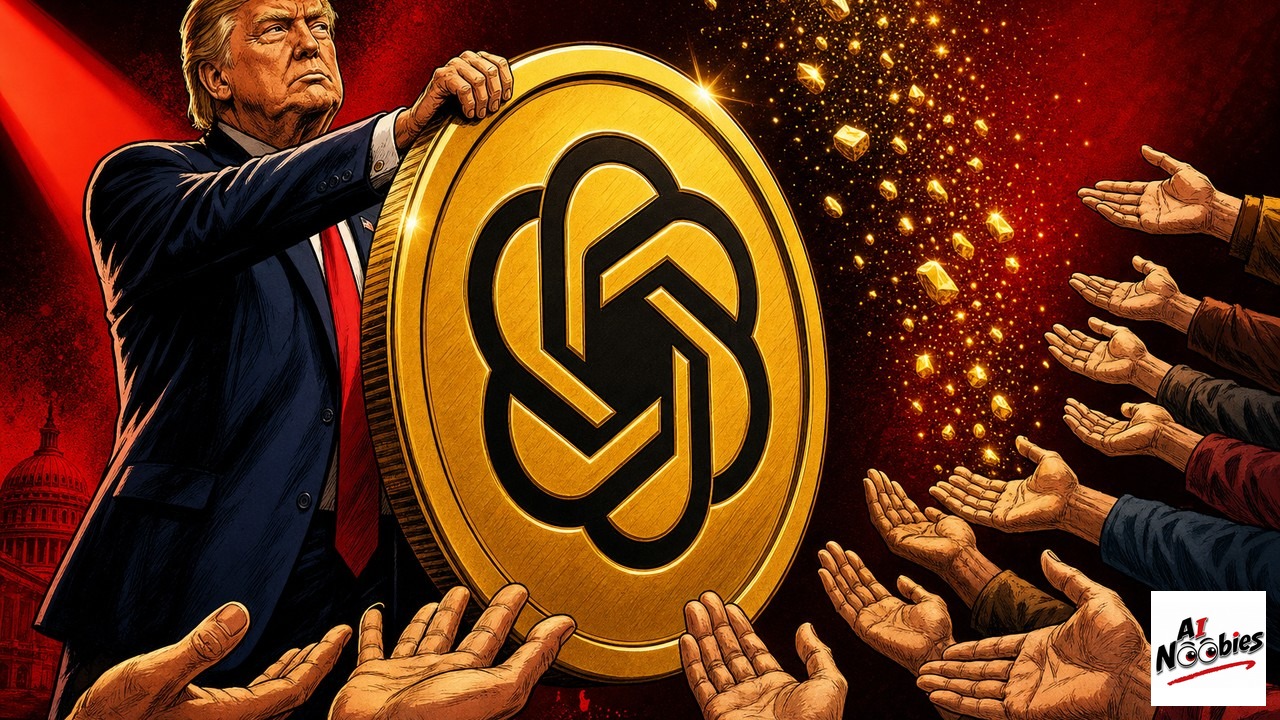
The Trump administration is talking about buying a piece of OpenAI. Yes, the government, taking shares of the company behind ChatGPT. The plan, still loose, would also pay part of the profits back to American citizens. Here is what Trump OpenAI actually means in plain English.
The Gist
- The U.S. government is exploring buying a stake (a part of the ownership) in OpenAI.
- Some of the money earned could fund a “Public Wealth Fund” that pays citizens directly.
- The Trump OpenAI idea echoes a similar move on Intel in 2025 and worries some of the tech world.
What is actually being discussed
On June 5 and 6, 2026, reports surfaced saying the White House is studying a way to take an equity stake in OpenAI. “Equity stake” simply means buying shares, like any investor would. The difference is who the investor is: the U.S. government itself. For context, see our earlier piece on AI Noobies: GPT-5.6: White House Picks Who Gets It First.
Trump said he wants deals where “the American people can benefit from the success of AI”. That sentence sums up the whole pitch. If OpenAI grows, the government would earn dividends, which could be paid out to regular citizens through a so-called Public Wealth Fund.
No numbers have been shared yet. We do not know how big the stake would be, how it would be paid for, or what voting rights would come with it. The Trump OpenAI idea is at the early talking-points stage, not at the contract stage.
This is not totally new. In 2025, the Trump administration already took 10% of Intel. The same playbook would be applied to AI. Sam Altman, OpenAI’s CEO, has been discussing the idea publicly since early 2025, so he is not surprised by the timing.
A Public Wealth Fund means a pool of money owned by the public, that pays a small amount to each citizen. The example cited is Alaska’s Permanent Fund, where every Alaskan receives a yearly check from oil revenue. The model exists, the question is whether it scales to AI.
Why this is more controversial than it sounds
The idea looks generous on paper. In practice, several voices in tech are pushing back hard. Senator Bernie Sanders prefers a different route: a 50% tax on AI company stock instead of a direct government stake. The reasoning is that a stake makes the State an active shareholder, with the power to influence what OpenAI builds and how.
David Sacks, who previously served as Trump’s AI czar, warned that the Trump OpenAI move could “accelerate the corporate-government fusion”. That phrase means the line between a private company and the government starts to blur. A government with a board seat can vote on what features ship, who gets hired, and how data is shared.
Dare Obasanjo, ex-Microsoft, reads the move differently. According to his comments, what is being framed as profit-sharing might actually be the early stage of a future government rescue if AI growth slows down. In short: the State as an emergency parachute, not just a co-investor.
Most regular users do not feel any of this yet. ChatGPT works the same way today as it did yesterday. The Trump OpenAI plan will not change your prompts. But over time, if it goes through, the kind of AI products available could shift, because the State would be sitting at the table when product calls are made.
Several AI companies plan to go public in 2026. A government stake taken right before an IPO is a very different scenario from a stake taken after. The political rights would be locked in before regular investors arrive on the market.
What it could mean for you
In the next few weeks, watch how OpenAI responds. The company has not officially confirmed anything yet. A long silence usually means real talks are happening behind the scenes. A clean denial would close the rumor fast. The middle ground signals real movement.
If a Public Wealth Fund actually gets built, the practical question for citizens becomes simple: how much, how often, and who qualifies. Alaska pays a few hundred to a few thousand dollars per resident per year, depending on oil prices. An AI-based fund would scale with how well OpenAI does, which is unpredictable today.
For people working with AI at their job, the medium-term effect is more about what gets built and what gets blocked. If the State has a board seat, certain product directions become easier (security, defense) and others become harder (content moderation, exports). The Trump OpenAI structure would tilt the roadmap.
For students and creators using ChatGPT, the day-to-day will not change immediately. The mood music will. AI as a private tech industry slowly turns into AI as part-government infrastructure. That is a real shift in how the technology will be discussed and regulated.
The most useful thing to remember: the Trump OpenAI talks are still early. No paperwork, no numbers, no signatures. But the fact that the conversation is happening in public says a lot. The State is no longer watching AI from a distance. It is asking for a seat at the table.
Follow the story on AI Noobies.
About the Author